
Exhibition dates: 24th September 2010 – 23rd January, 2011

Agnolo di Cosimo named Bronzino (Monticelli, Florence 1503 – Florence 1572)
Holy Family with St Anne and St John
1545 or 1546
Oil on panel
124.5 x 99.5cm
Vienna, Kunsthistorisches Museum, Gemäldegalerie, inv. n. 183
Despite the sensitivity of the religious paintings it is the portraits of strong yet somehow vulnerable women that move me most in this posting. The paintings are “often read as static, elegant, and stylish exemplars of unemotional haughtiness and assurance.” (Wikipedia)
I don’t agree. Of course they have the trappings of the rich and powerful, the knowledgeable books at hand, the elongated Mannerist hands, the lush colours and detail of their pleated robes falling from their shoulders like liquid opulence (imagine the shock of these colours in 1530!) but there is something in their open stare that seems to reach across time to tap me on the shoulder and say yes, I can still see into your soul as you can into mine. Incredibly moving this work of genius.
Dr Marcus Bunyan
Many thankx to the Palazzo Strozzi, Florence for allowing me to publish the photographs of the paintings in the posting. Please click on photographs for a larger version of the image.
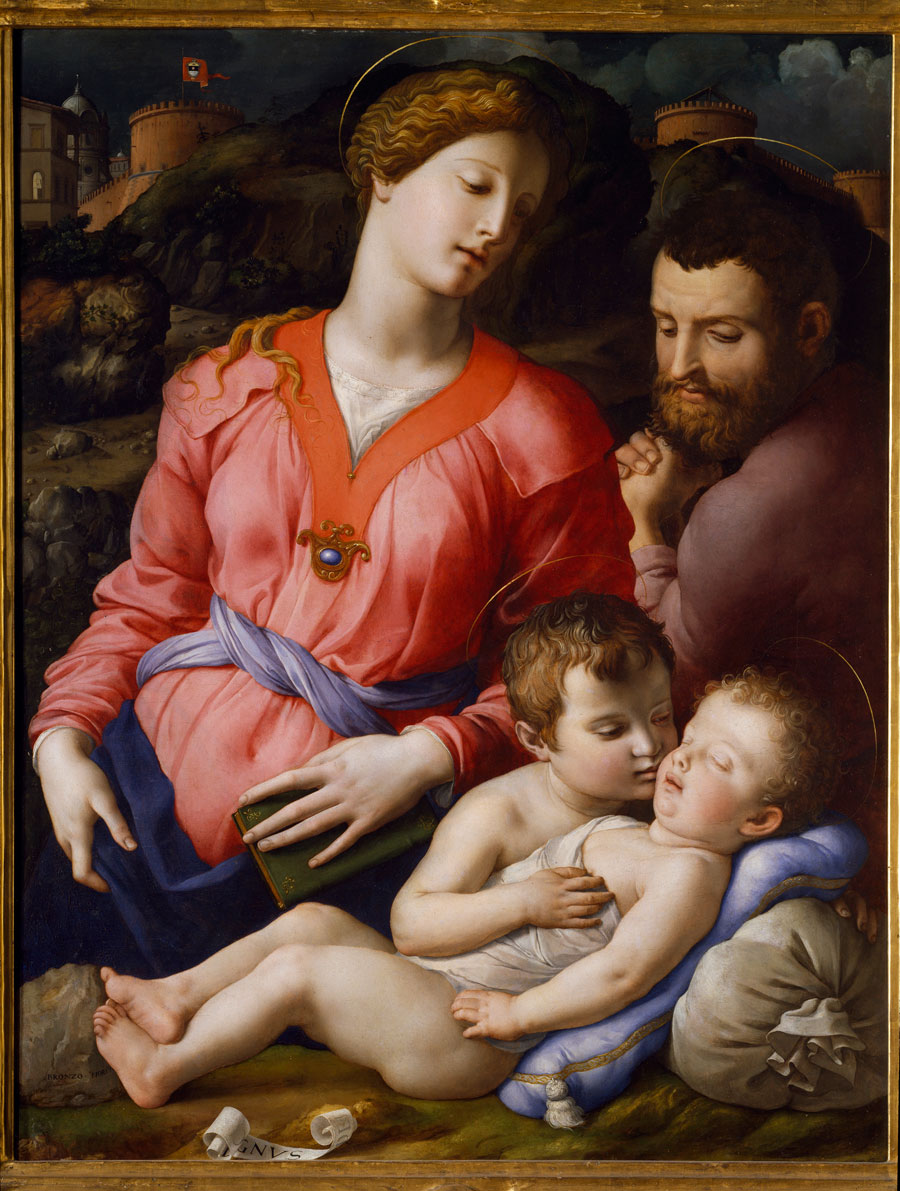
Agnolo di Cosimo named Bronzino (Monticelli, Florence 1503 – Florence 1572)
Holy Family with St John (Panciatichi Madonna)
c. 1540
Oil on panel
116.5 x 89.5cm
Florence, Galleria degli Uffizi, Inv. 1890 n. 8377

Agnolo di Cosimo named Bronzino (Monticelli,Florence 1503 – Florence 1572 )
Portrait of Eleonora of Toledo with her son Giovanni
c. 1545
Oil on panel
115 x 96cm
Florence, Galleria degli Uffizi, Inv. 1890 n. 748
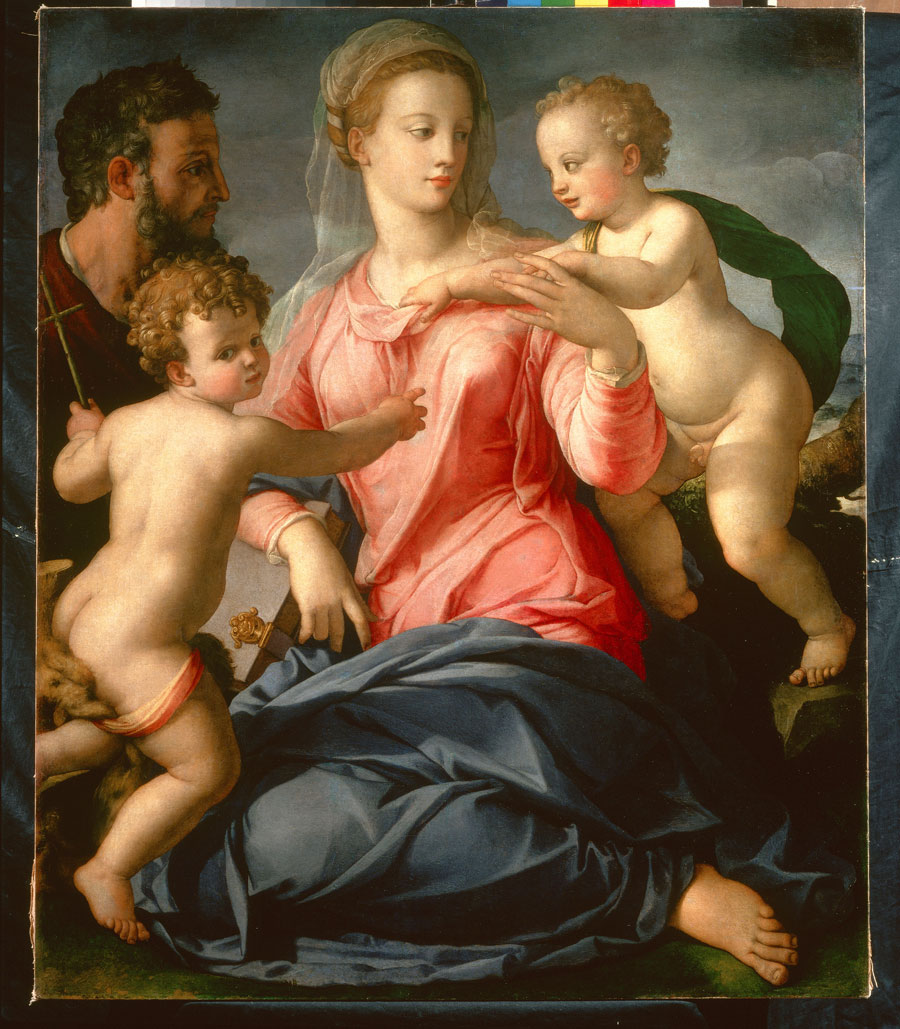
Agnolo di Cosimo named Bronzino and Alessandro Allori (Bronzino (Monticelli, Florence 1503) Allori (Florence 1535) – Bronzino (Florence 1572) Allori (Florence 1607))
Holy Family with St John
c. 1555-1559
Tempera on panel
117 x 99cm
Moscow, State Pushkin Museum of Fine Arts. Inv.2699
Agnolo di Cosimo, known as Bronzino (1503-1572), was one of the greatest artists in the history of Italian painting. Court artist to Cosimo I de’ Medici (1519-1574), his work embodied the sophistication of the Mannerist style. Bronzino. Artist and Poet at the Court of the Medici, on view at the Palazzo Strozzi in Florence from 24 September 2010 to 23 January 2011, will be the very first exhibition devoted to his painted work. Bronzino conveyed the elegance of the Medici court in his work with “naturalness” and, at the same time, austere beauty.
Florence is the perfect setting for a monographic exhibition on Bronzino. The son of a butcher, not only was he born and died here, the city houses some of his greatest masterpieces, particularly in the Uffizi but also in other museums and churches. This landmark exhibition, with loans from the world’s most important museums, presents presents 63 works attributed to Bronzino, and 10 to Bronzino and his workshop, along with others by his master Pontormo, with whom he had close ties throughout his life. Bronzino’s paintings, with their sculptural definition, will be shown alongside sculptures by such 16th century masters as Benvenuto Cellini, Tribolo, Baccio Bandinelli and Pierino da Vinci, who were his friends and with whom he exchanged sonnets. The exhibition concludes with a number of works by Alessandro Allori, his favourite pupil.
Most of these jewel-like masterpieces have never been shown together. Alongside the paintings from the Uffizi, the exhibition will include such works as The Adoration of the Shepherds and the Allegory of Venus, Cupid and Jealousy from the Szépmüvészeti Múzeum in Budapest, the Venus, Cupid and Satyr from the Galleria di Palazzo Colonna in Rome, the Portrait of a Young Man with a Book from the Metropolitan Museum of Art in New York, and the Holy Family with St Anne and St John in the versions in the Musée du Louvre in Paris and the Kunsthistorisches Museum in Vienna, together with panel paintings from the J. Paul Getty Museum, Los Angeles, and from the National Gallery of Art, in Washington.
The exhibition will show three hitherto ‘missing’ works by Bronzino, two of which, while recorded and mentioned by Giorgio Vasari, were thought to have been lost: the Crucified Christ which he painted for Bartolomeo Panciatichi, and the St Cosmas, the right-hand panel accompanying the Besançon altarpiece when it originally graced Eleonora da Toledo’s chapel in Palazzo Vecchio. Their rediscovery sheds new light on Bronzino’s work and on his ties with the heretical religious mood that permeated the Medici court before 1550. The third previously unknown picture is Christ Carrying the Cross ascribed to his later years.
The exhibition, which has taken over four years to prepare, is curated by Carlo Falciani and Antonio Natali, the foremost experts on Cinquecento painting who have also contributed to the scholarly catalogue. The exhibition, in conjunction with Drawings of Bronzino at the Metropolitan Museum of Art in New York (20 January to 18 April 2010), will play a central role in fostering a new interpretation of this important artist. For those who enjoyed the New York show, this Florence exhibition is a must-see.
Press release from the Palazzo Strozzi website [Online[ Cited 17/01/2011 no longer available online

Agnolo di Cosimo named Bronzino (Monticelli, Florence 1503 – Florence 1572 )
Portrait of Lorenzo Lenzi
1527
Oil on panel
90 x 71cm
Milan, Civiche Raccolte Artistiche – Pinacoteca del Castello Sforzesco

Agnolo di Cosimo named Bronzino (Monticelli,Florence 1503 – Florence 1572 )
Portrait of Guidubaldo II della Rovere
1531-1532
Oil on panel
114 x 86cm
Florence, Palazzo Pitti, Galleria Palatina, inv. 1912 n. 149

Agnolo di Cosimo named Bronzino (Monticelli, Florence 1503 – Florence 1572)
Portrait of a Women (Matteo Sofferoni’s Daughter?)
c. 1530-1532
Oil on panel
76.6 x 66.2 x 1.3cm
London, Lent by Her Majesty Queen Elizabeth II, RCIN 405754

Agnolo di Cosimo named Bronzino (Monticelli,Florence 1503 – Florence 1572 )
Portrait of Lucrezia Panciatichi
1540
Oil on panel
101 x 82.8cm
Florence, Galleria degli Uffizi
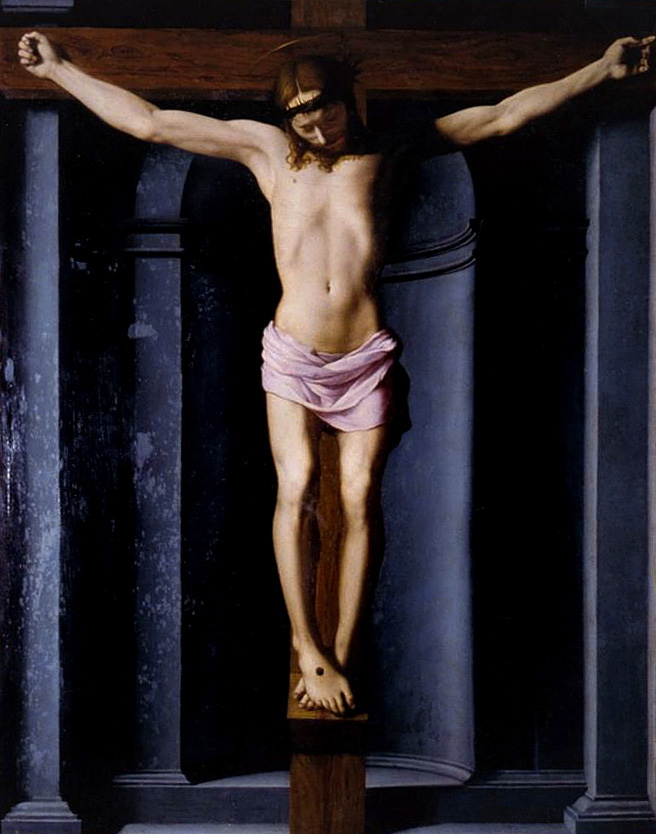
Agnolo di Cosimo named Bronzino (Monticelli,Florence 1503 – Florence 1572)
Christ on the Cross, Agnolo Allori
c. 1540
Oil on panel
145 x 115cm
Musée des Beaux-Arts
The Crucifixion (1540-1541 circa) is the third and most intriguing of the debuts in that it tells us something about the religious sensibilities of Bartolomeo and Lucrezia Panciatichi who were tried for heresy between 1551 and 1552. Only the direct intervention of Duke Cosimo I stayed off their conviction. Carlo Falciani and Philippe Costamagna used Vasari’s description and other historical records to identify the piece hanging in Nizza with the label “anonymous Italian work”. Reflectographic analysis shows that it was painted according to the modus operandi of Bronzino himself, who used a preparatory drawing modified several times. According to the original plan, Christ hung more heavily from the cross with head drooping, arms distended, and legs bent. Such a posture would have evoked the preaching of Savonarola, for whom the sufferings of Christ are a stark warning about the consequences of sin. To have extolled these sufferings in the painting would have emphasized the necessity of humans to suffer for their salvation. The Panciatichi, however, persuaded by the poetry of Juan de Valdès, wished that the painting show that salvation comes by faith alone, in such a way that suffering is no longer necessary since Christ himself has already suffered.
To reflect the theology of justification by faith alone, Bronzino ignored the original drawing and instead painted Christ already deceased rather than in the throes of agony. Vasari writes that the artist worked long and hard to render the composition more calm and serene. The statuesque corpse is affixed lightly to the cross, which in turn is situated in an altar-niche rather than on Mount Calvary, suggesting that the painting is a memorial in the same way the eucharist is but a memorial according to the theology the Panciatichi found so attractive.
Daniel B. Gallagher. “Bronzino; Medici Court Painter and poet at the palazzo Strozzi, Florence,” on the New York Arts website, January 10, 2011 [Online] Cited 21/02/2025

Agnolo di Cosimo named Bronzino (Monticelli,Florence 1503 – Florence 1572)
Nano Morgante
Before 1553
Oil on canvas
Uffizi Gallery, Florence

Agnolo di Cosimo named Bronzino (Monticelli,Florence 1503 – Florence 1572)
Venus, Cupid and Satyr
1553-1554
Oil on panel
135 x 231cm
Palazzo Colonna

Agnolo di Cosimo named Bronzino (Monticelli,Florence 1503 – Florence 1572 )
Portrait of Laura Battiferri
c. 1555-1560
Oil on panel
83 x 60cm
Florence, Palazzo Vecchio, Collezione Loeser

Agnolo di Cosimo named Bronzino (Monticelli, Florence 1503 – Florence 1572)
Francesco I De Medici
between 1555 and 1565
Oil on panel
97.9 (38.5 in) x 76.4cm (30 in)
Art Institute of Chicago
Palazzo Strozzi
Piazza Strozzi, 50123
Firenze (Florence), Italy
Phone: +39 055 2645155
Opening hours:
Daily 10am – 8pm, Thursday 10am – 11pm
Last admission to the exhibition one hour before closing
 Art Blart _ art and cultural memory archive
You must be logged in to post a comment.