
Exhibition dates: 18th October, 2025 – 19th April, 2026
Curator: Louise Pearson
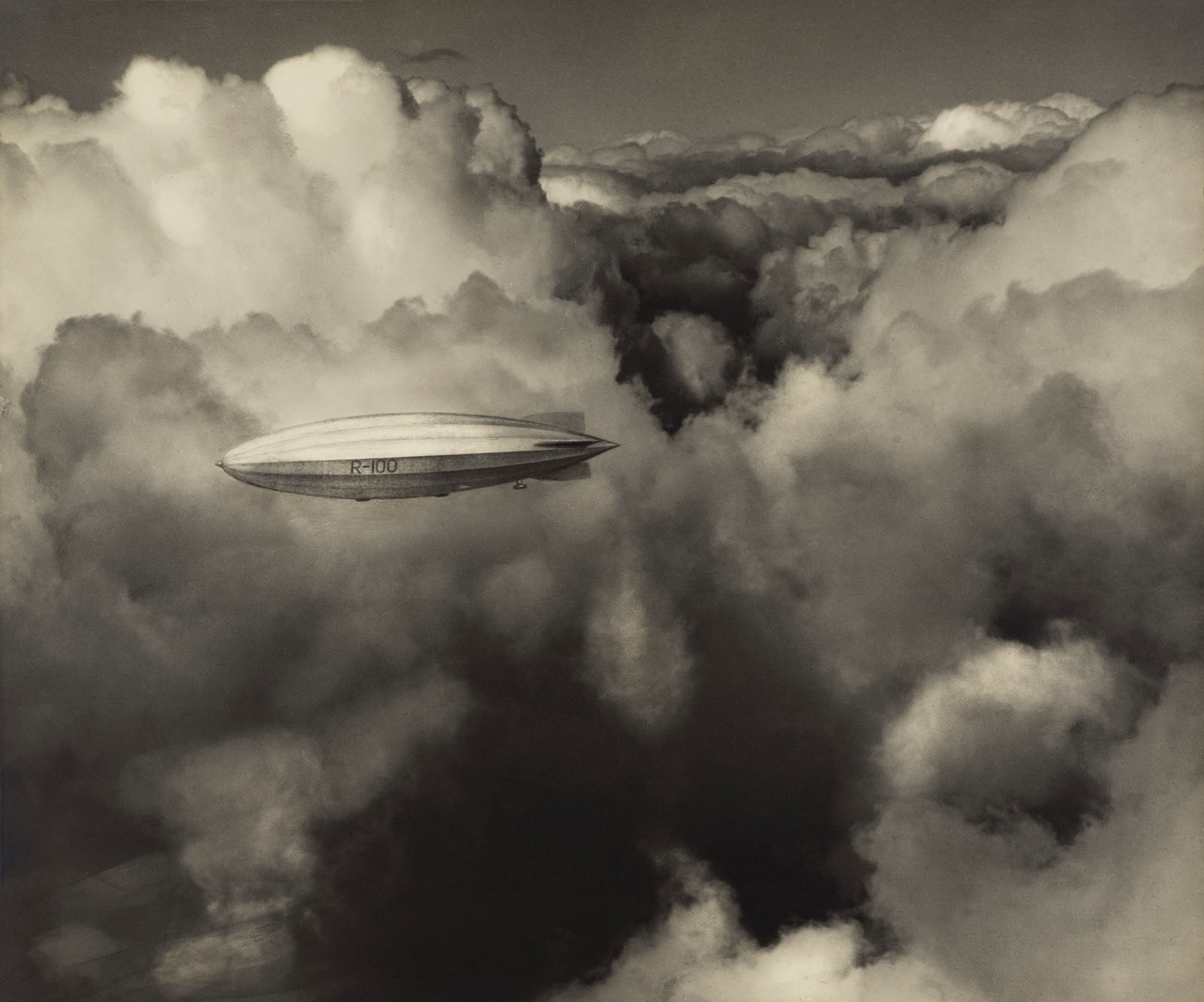
Alfred Buckham (British, 1879-1956)
R100
about 1920
Gelatin silver print
National Galleries of Scotland
Purchased with Art Fund support, 2008
© Richard and John Buckham
This is an example of one of his shots of an impressive cloud formation. It features the R-100 airship, noted for its more oval, aerodynamic shape in comparison to the traditional Zeppelin. The R-100 embarked on its maiden flight in 1929 but in 1930 it was deflated and removed from service following the crash of her sister ship, the R-101, with the loss of forty-eight lives. Buckham painted the airship into the scene by hand.
Flights of fancy
What a man, what a daredevil, what an artist!
Member of the Royal Photographic Society and lecturer in photography before the First World War.
Joined the Royal Naval Air Service (precursor to the Royal Air Force) in 1916 and taught young recruits the basics of photography before requesting a transfer to active service. He became a pioneer in aerial reconnaissance over France when the pilots and observers/camera operators of biplanes over the trenches had no parachutes.
Invalided out of the service in 1918 after multiple crashes. After his ninth crash he had to undergo a tracheotomy and spent the rest of his life breathing through a tube.
Determined to continue his love affair with flying and photography, he rented planes and, strapping himself in and leaning over the side with his heavy plate camera, he captured romantic, rugged, aerial landscape photographs which combined dramatic, atmospheric shots of the landscape with photographic manipulation inside and outside the darkroom.
Rather than scratching in the original negative and/or making a composite negative (a la the Australian photographer Frank Hurley, 1885-1962) or using photomontage (the cutting and pasting physical photographs together), Buckham used combination printing – the use of multiple negatives to create seamless, “perfect” images, such as adding detailed skies to landscapes and biplanes to the skies, planes that were photographed on the ground – in the final, unique print. He often scratched the final print to emphasise highlights, and then used watercolour paints to blend in the areas where the different negatives overlapped in the print or to paint in details of aircraft wheels or bridge supports.
Buckham’s photographs of the landscape are truly beautiful. I love them.
The final prints are a heady mixture of romantic landscape (with their underlying nod to Pictorialism, emotional, romantic, and atmospheric scenes over realistic documentation) and modernist elements, of cutting edge machines, bridges, aeroplanes, airships and flying boats added through photographic manipulation in the darkroom, further enhanced by hand, through scratching and painting on the actual print.
To finally reveal what Buckham felt of the physical thrill of flying and the deeply felt emotional reaction to the landscape beneath him – can you imagine being him! – creating these photographs with deep, inward feelings impinging on his mind, his imagination, his memory. To perfectly present “so nearly, the effect that I saw” when in the air. Clouds in a sea of air.
These. These were his flights of fancy.
Dr Marcus Bunyan
Many thankx to the Scottish National Portrait Gallery for allowing me to publish the photographs in the posting. Please click on the photographs for a larger version of the image.
“I always stand up to make an exposure and, taking the precaution to tie my right leg to the seat, I am free to move about rapidly, and easily, in any desired direction; and loop the loop, and indulge in other such delights, with perfect safety… If you stand erect you will not have to resist the fatal tendency to rest your arms on the side of the aeroplane whilst making the exposure, for if you do so your photograph will surely be spoiled by the vibration of the engine.”
“Unfortunately, Nature does not always surmount her landscapes with clouds such as will compose well, as a whole, in the picture space, consequently I have provided a store of over 2,000 cloud negatives for such contingencies and from this suitable clouds for combination purposes are selected. And here is just where the hasty or unobservant worker may go badly astray, producing incredible or even appalling results. For the lighting of the landscape must be in correct relation to the light coming down from the sky, and heavy cloud masses insist that they shall have corresponding shapes upon the earth. Selection for the right negative for the purpose may entail the inspection of fifty or more, and on the print some handwork with a chemical reducer and stumping chalk, or other medium, is usually required to bring the whole into harmony. So before venturing upon combination work it is surely wise to serve some years of apprenticeship sketching and painting in the open air, which happens to have been my own way of approach to photography.”
“The open cockpit of a not-too-speedy airplane affords better facilities for working than a cabined plane. When the best weather conditions prevail for pictorial photography, the skyroad is disposed to be bumpy, descending and ascending currents of air moving beneath the big banks of cumulus cloud. A sudden drop of 300 or 400ft may be a little alarming if one is not prepared for it.”
Alfred Buckham
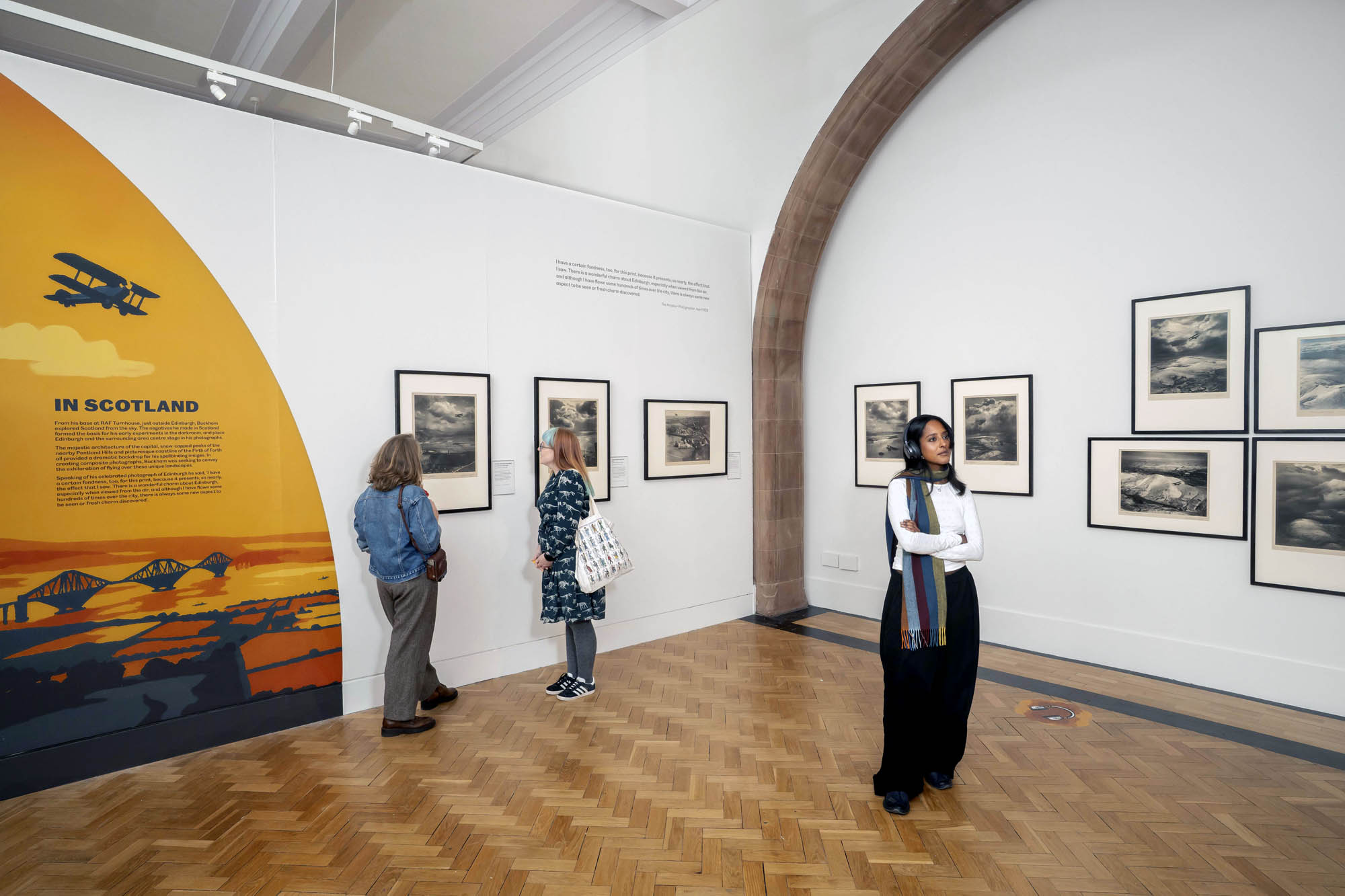
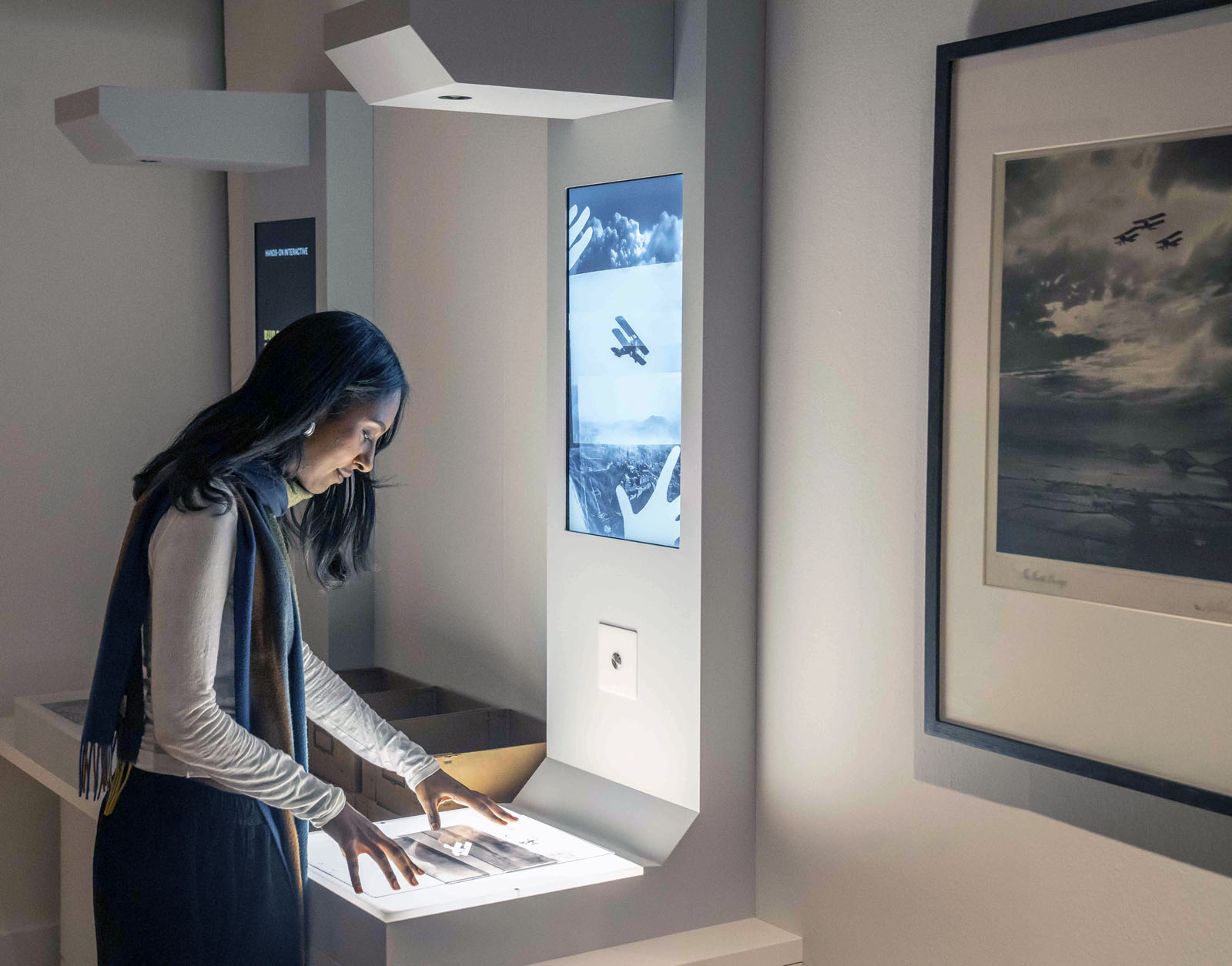
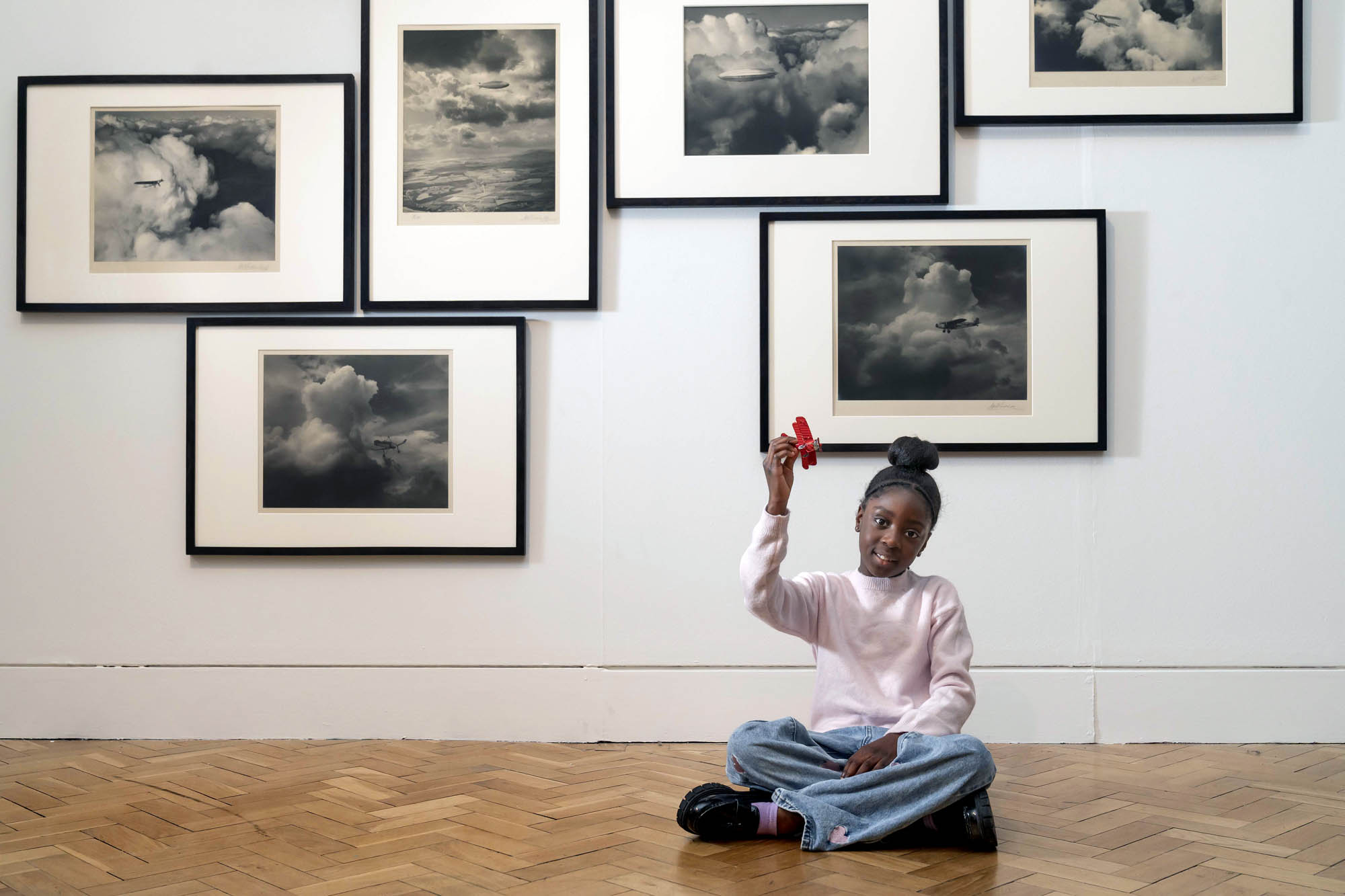
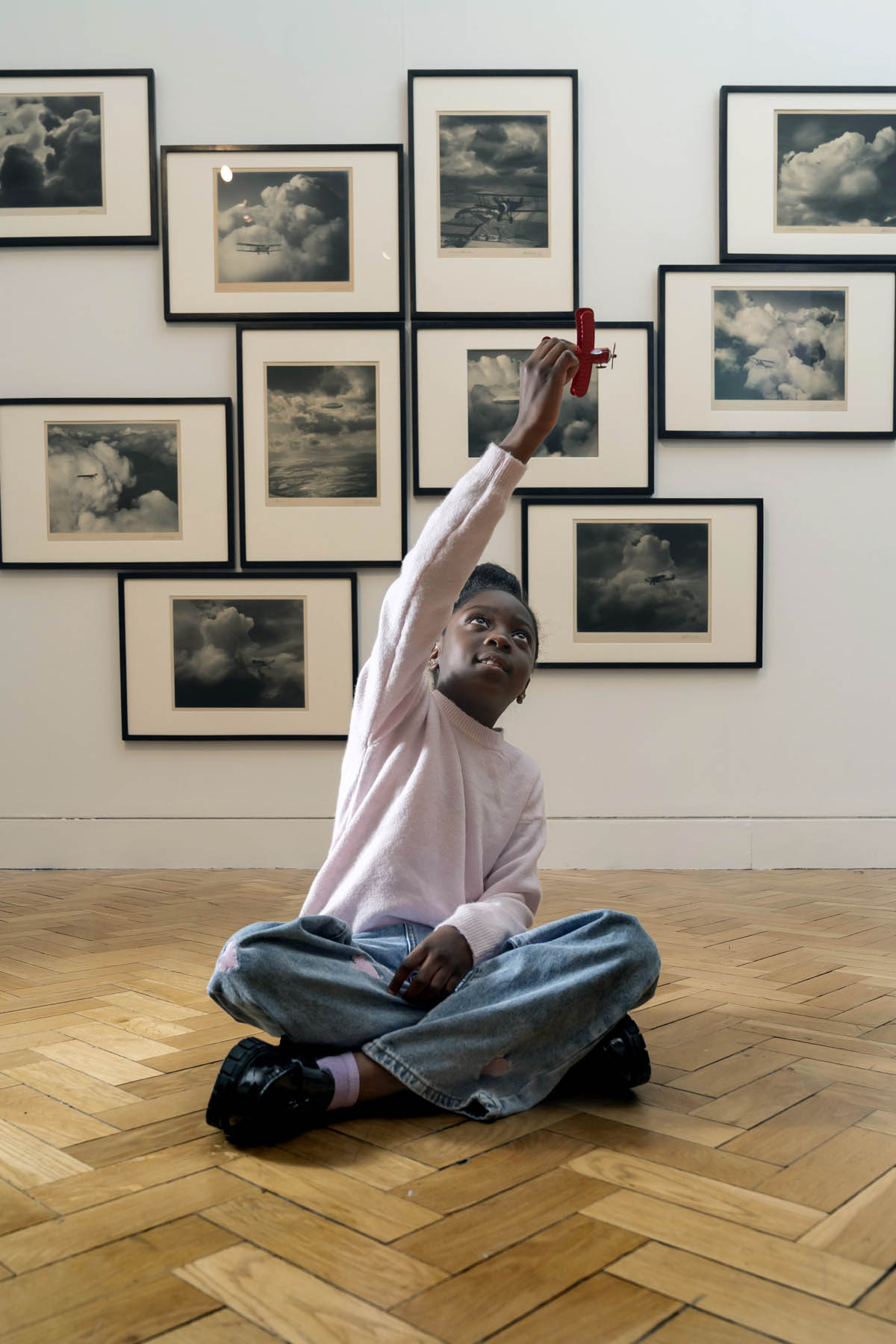
Installation views of the exhibition Alfred Buckham: Daredevil Photographer at the Scottish National Portrait Gallery, Edinburgh
Photos: Aly Wight
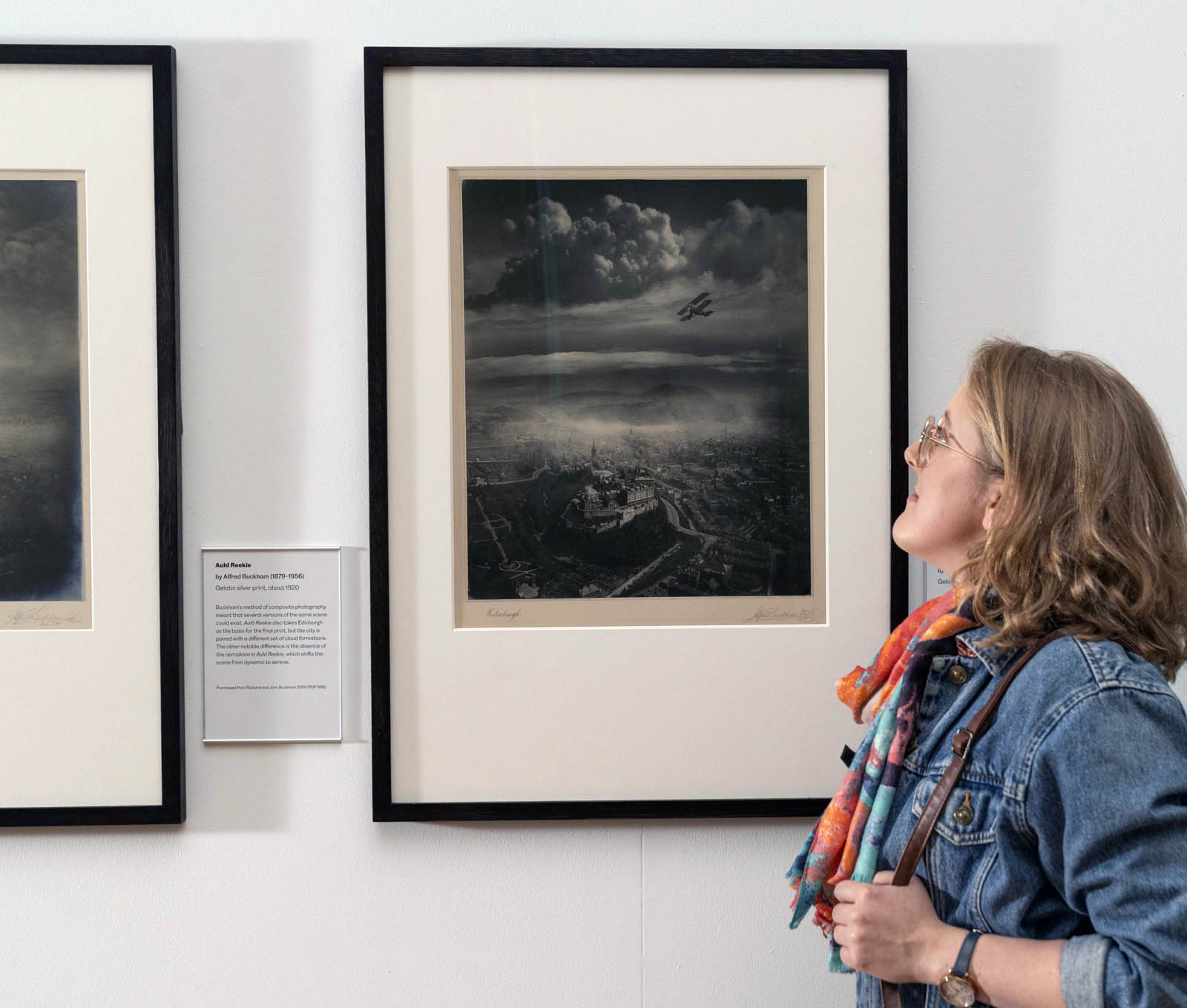
Installation view of the exhibition Alfred Buckham: Daredevil Photographer at the Scottish National Portrait Gallery, Edinburgh showing Buckham’s photograph Edinburgh (about 1920, below)
Photo: Aly Wight
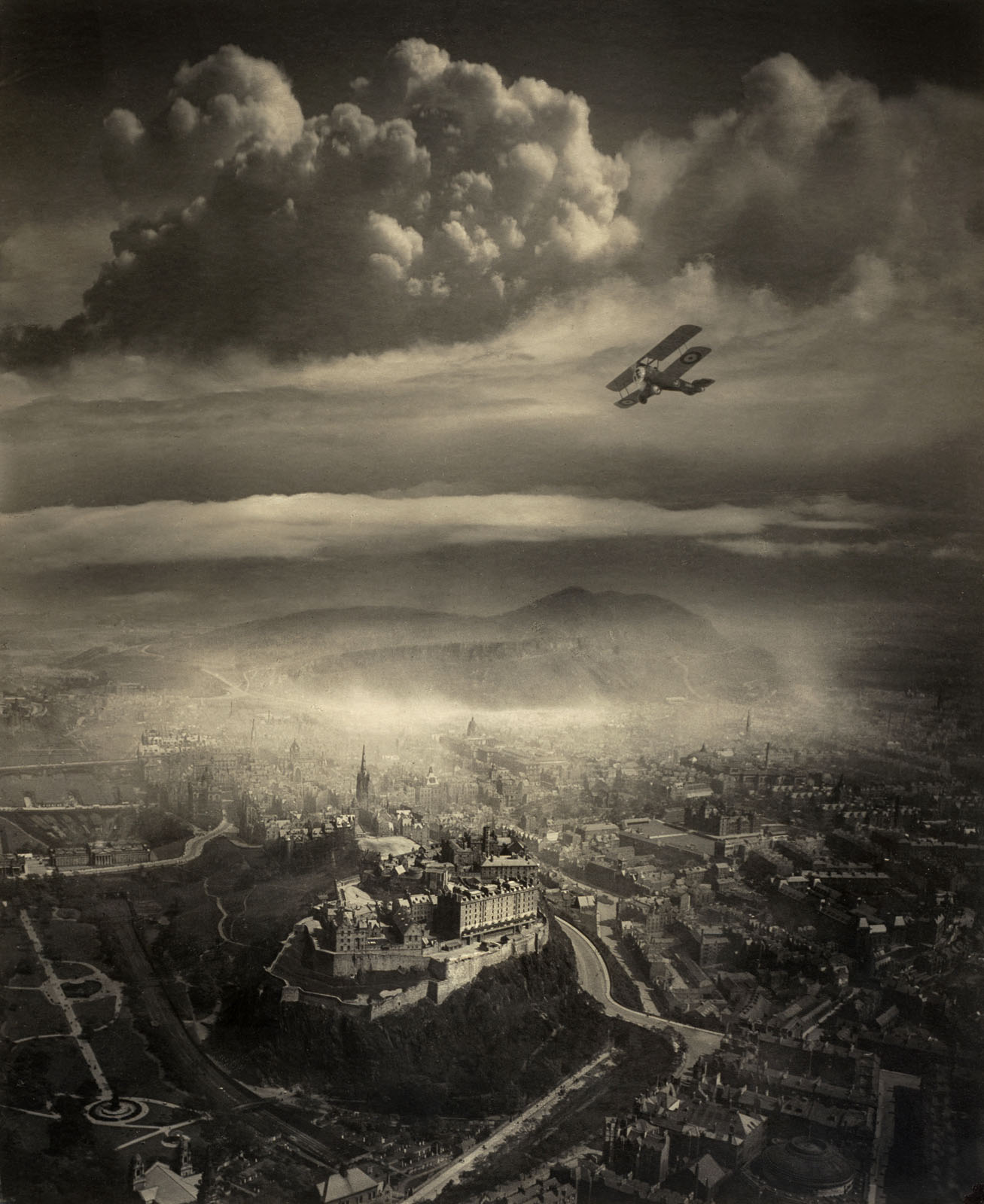
Alfred Buckham (British, 1879-1956)
Edinburgh
about 1920
Gelatin silver print
45.80 x 37.80 cm
Scottish National Gallery of Modern Art
Purchased 1990
© Richard and John Buckham
Buckham had crashed nine times before he was discharged from the Royal Naval Air Service as a hundred per cent disabled. Continuing to indulge his passion for aerial photography, he wrote that ‘If one’s right leg is tied to the seat with a scarf or a piece of rope, it is possible to work in perfect security’. Presumably these were the perilous conditions in which the photographer took this dazzling picture of Edinburgh, one of the city’s most popular aerial views.
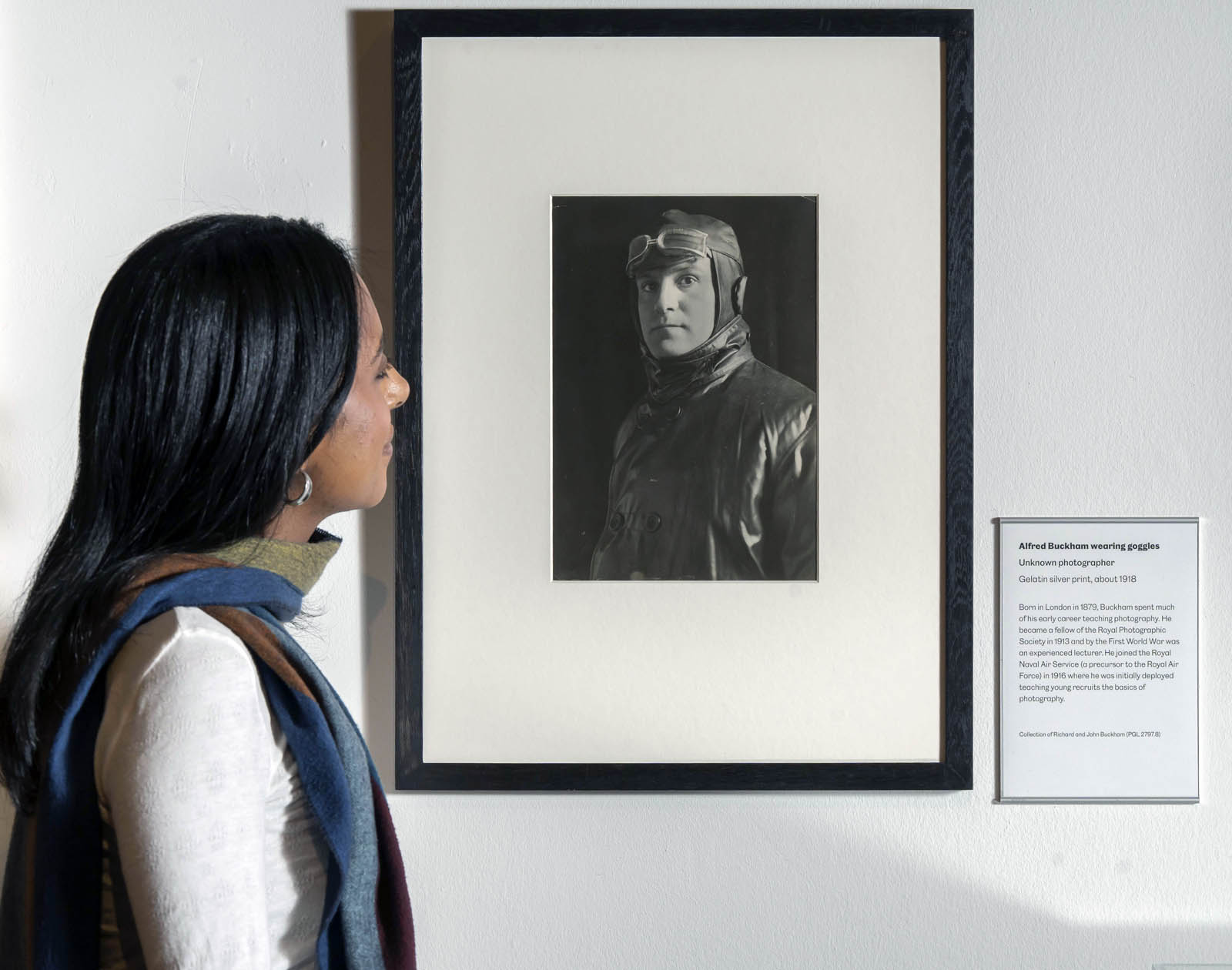
Installation view of the exhibition Alfred Buckham: Daredevil Photographer at the Scottish National Portrait Gallery, Edinburgh showing Alfred Buckham wearing googles by an unknown photographer (1918, below)
Photo: Aly Wight
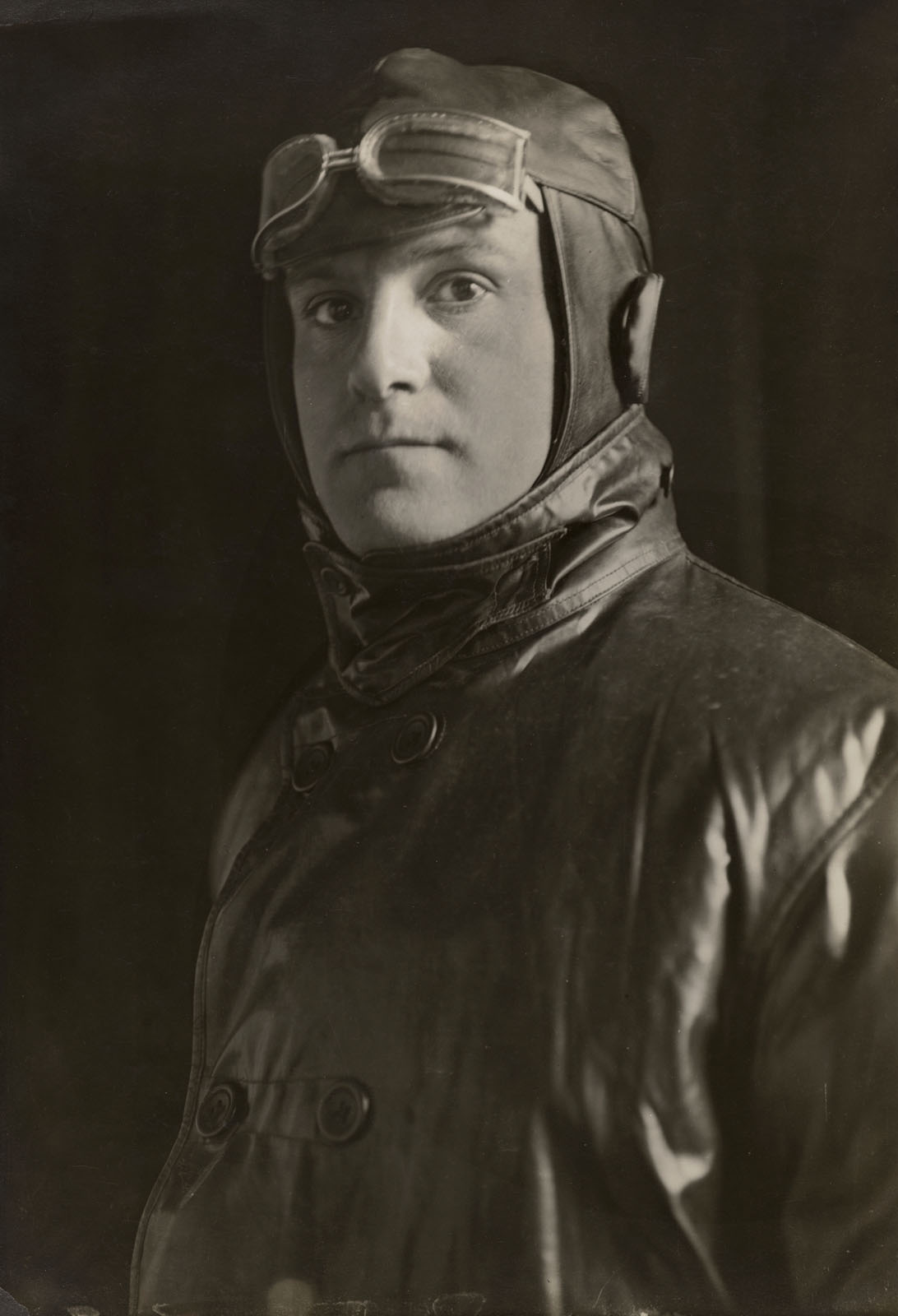
Unknown photographer
Alfred Buckham wearing googles
1918
Gelatin silver print
Collection of Richard and John Buckham
© Richard and John Buckham
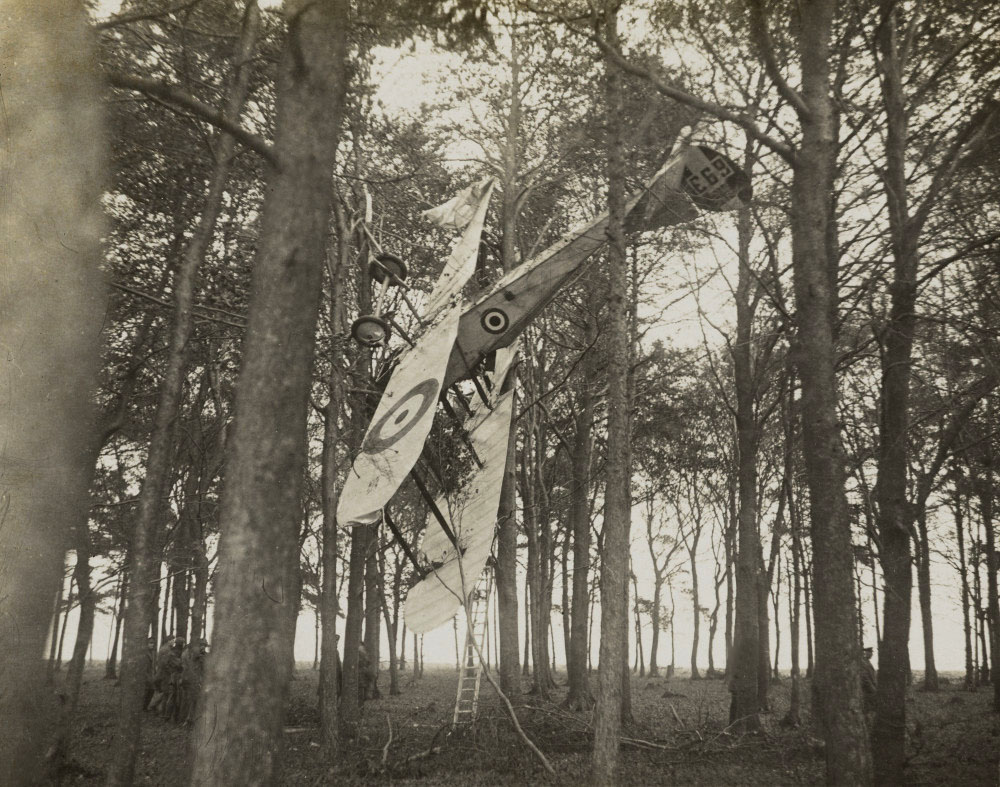
Unknown photographer
Alfred Buckham’s aeroplane hanging in a tree after a crash during the First World War
1916
Gelatin silver print
Collection of Richard and John Buckham
© Richard and John Buckham
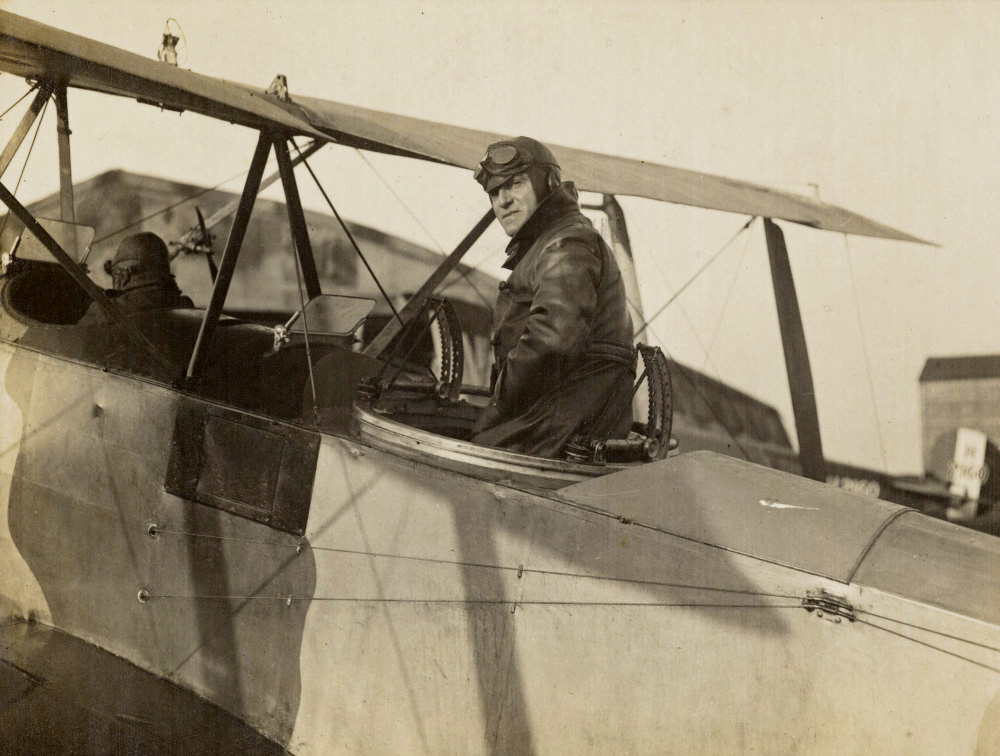
Unknown photographer
Alfred Buckham in an aeroplane
1918
Gelatin silver print
Collection of Richard and John Buckham
© Richard and John Buckham
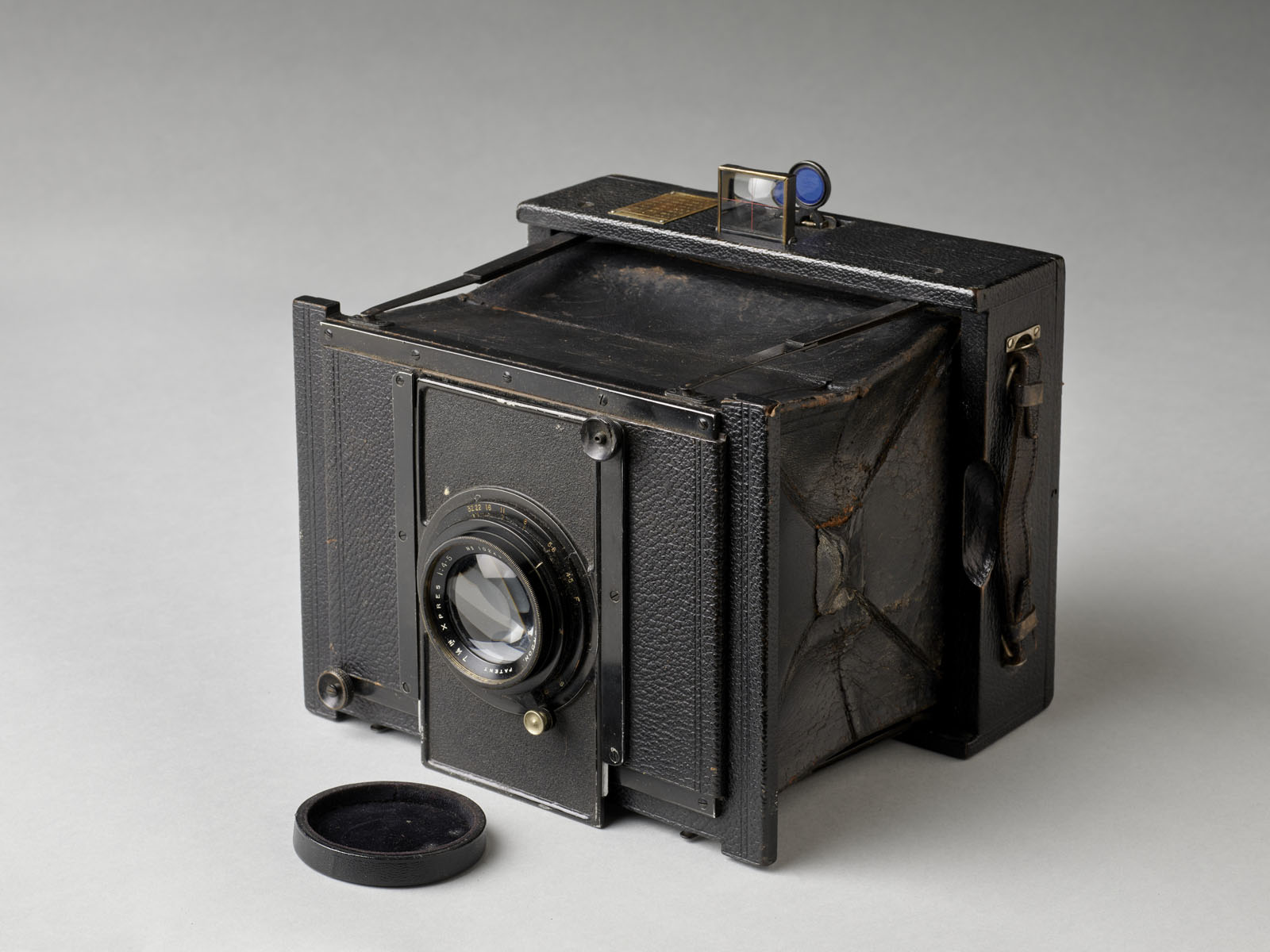
Unknown photographer
Camera belonging to Alfred G. Buckham
about 1920
National Galleries of Scotland
Purchased from Richard and John Buckham, 2019
© Richard and John Buckham
Take to the skies and discover the world from above the clouds through the remarkable work of Alfred Buckham: Daredevil Photographer.
A trailblazer in his field, Alfred Buckham soared above the realms of what was thought to be possible in 20th century photography and aviation. Meet the man behind some of the most iconic aerial photographs, marvel at the death-defying lengths he took to capture the perfect image and explore how his innovative techniques paved the way for modern technologies such as Photoshop and AI.
Text from the Scottish National Portrait Gallery website
Alfred Buckham’s first ambition was to be a painter, but after seeing JMW Turner’s pictures in the National Gallery in London, he returned home and made a bonfire of his own work. He was the first head of aerial reconnaissance for the Royal Navy in the First World War and later a captain in the Royal Naval Air Service. After crashing nine times he was obliged to undergo a tracheotomy and was discharged as a hundred per cent disabled. While recovering from surgery Buckham started making photo-montages, combining two or three photographs he had taken to compose a single image. He would look for a sky which complemented the city or landscape below, and even add tiny planes to create the look of a one-shot photograph. He continued to take aerial photographs with a heavy plate camera, leaning perilously out of the aeroplane, where his delight in picture making greatly increased the risk of accident.
Text from the National Galleries website
Secrets of the Darkroom | Alfred Buckham
Transcript
Narrator: Lucy Armitage
Video duration: 00:03:43
[This film consists of animations illustrating the photographic techniques described in the narration]
Narrator
How would you have combined multiple photographs into one image in the days before Photoshop? From wartime aerial reconnaissance photographer to intrepid explorer, Alfred Buckham was a true daredevil.
But when he entered the darkroom, he was a meticulous and innovative artist. Let’s take a look at one of his most iconic composite photographs: Edinburgh, which was made using three separate negatives.
The first stage would have been to select one of the negatives he captured while literally dangling from his cockpit at death-defying heights.
He would then select a second negative from his impressive library of over 2,000 negatives of clouds. Selecting the right clouds sometimes required inspecting 50 or more options, and occasionally, he created new cloud formations by taping two negatives together.
He also built up a library of plane negatives, masking each plane from the background. All these planes were photographed from the ground, because it would have been impossible to capture a clear image of a plane, mid-flight, from another moving vehicle.
To make a photographic print, the negative would be placed into a device called an enlarger. Think of it like a top-down projector, shining light through the negative to project its image onto a sheet of light-sensitive photographic paper.
This paper would become a canvas for combining multiple negatives into one image. Buckham would first expose the image of Edinburgh onto the lower half of the paper for just the right amount of time. Next, he would expose the image of the sky onto the upper half. The longer the light projected the negative onto the paper, the darker the final image would be.
Throughout the exposure process, he used dodging and burning techniques to soften the horizon where the two negatives met. Dodging involves using your hand, or a piece of card, to block light on specific areas of the paper during exposure, making them appear lighter in the final print. Burning works in the opposite way, where you block light on the areas you’re happy with, and expose for longer the areas you want to darken.
Buckham used a pin mark to identify his chosen spot for the aeroplane. He would have to adjust the height of the enlarger to change the apparent size of the aeroplane. In this case, he also inserted the negative into the enlarger back to front to reverse the plane’s direction. Did you spot the backwards tail number?
After all three exposures, he would then place the paper into a shallow chemical bath called a developer for a set time. Slowly, as if by magic, the composite image would begin to appear on the paper. Subsequent chemical baths stopped the development process before fixing the image in place.
After washing and drying the paper, the print was ready for final adjustments. Buckham rarely edited negatives directly, as was common for photographers using glass plates. Instead, he made all his final adjustments in the print.
Here, he has used black watercolour to enhance the contrast between the brooding castle and the rest of the city. He would sometimes scratch away dark areas of the print to reveal the lighter colour of the paper beneath. Using this method, he could create the impression of spinning propeller blades or light glinting on key landmarks.
These artistic interventions resulted in each print being truly unique. Buckham’s photographs not only capture breathtaking moments at daring, dizzying heights, but are also the meticulous creations of a pioneering visionary artist.
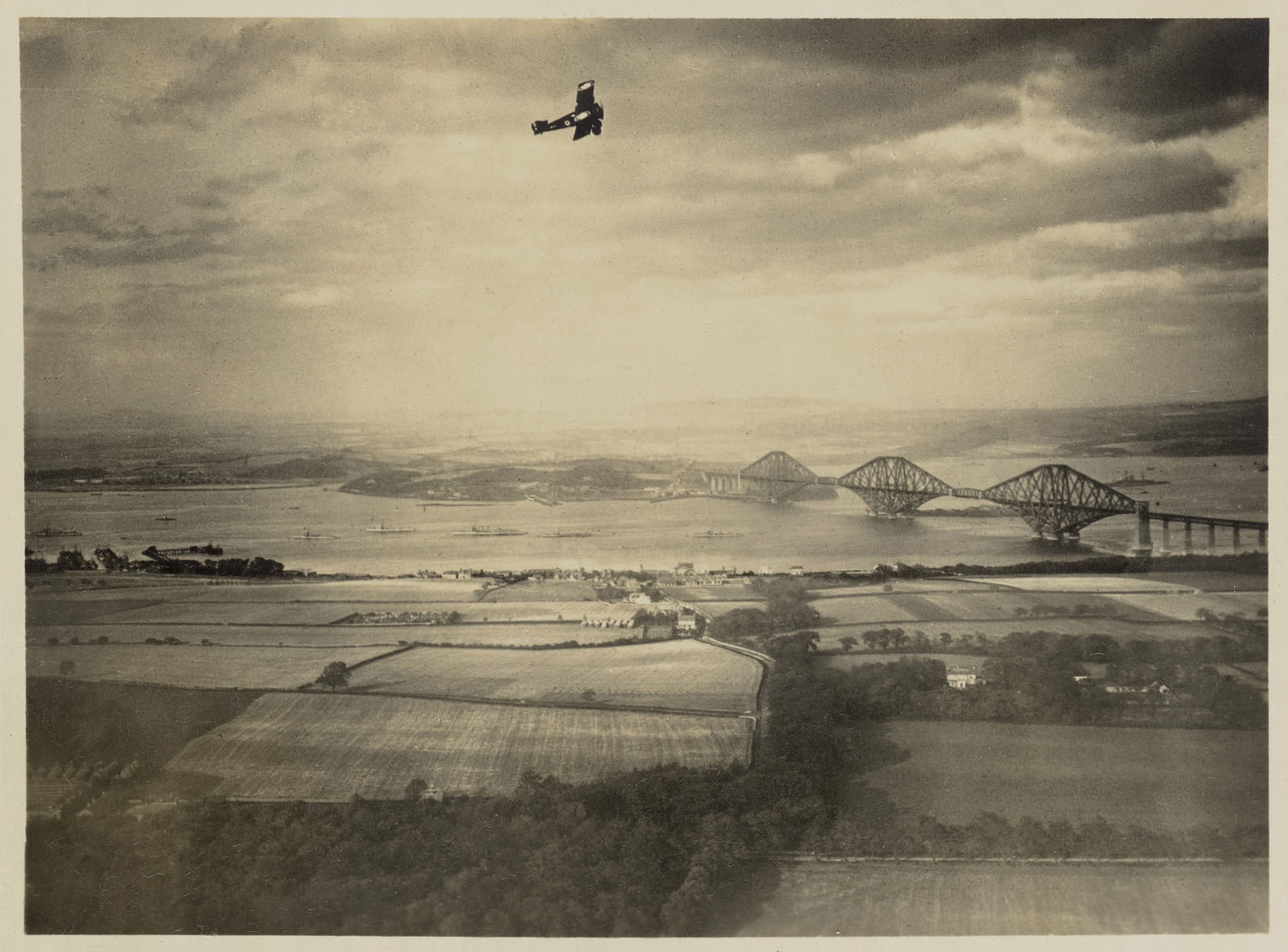
Alfred Buckham (British, 1879-1956)
RAF Turnhouse Christmas Card
1918
Gelatin silver print
National Galleries of Scotland
Gift of the Bartholomew Family, Edinburgh, 2022
© Richard and John Buckham
A negative of The Forth Bridge, looking north towards Fife, was used as the basis for several prints. It was also used to produce this Christmas card for RAF Turnhouse in 1918. Showing an aeroplane flying towards the Forth Bridge, this is probably one of the first composite photographs Buckham created as it was made while he was still serving in the air force.
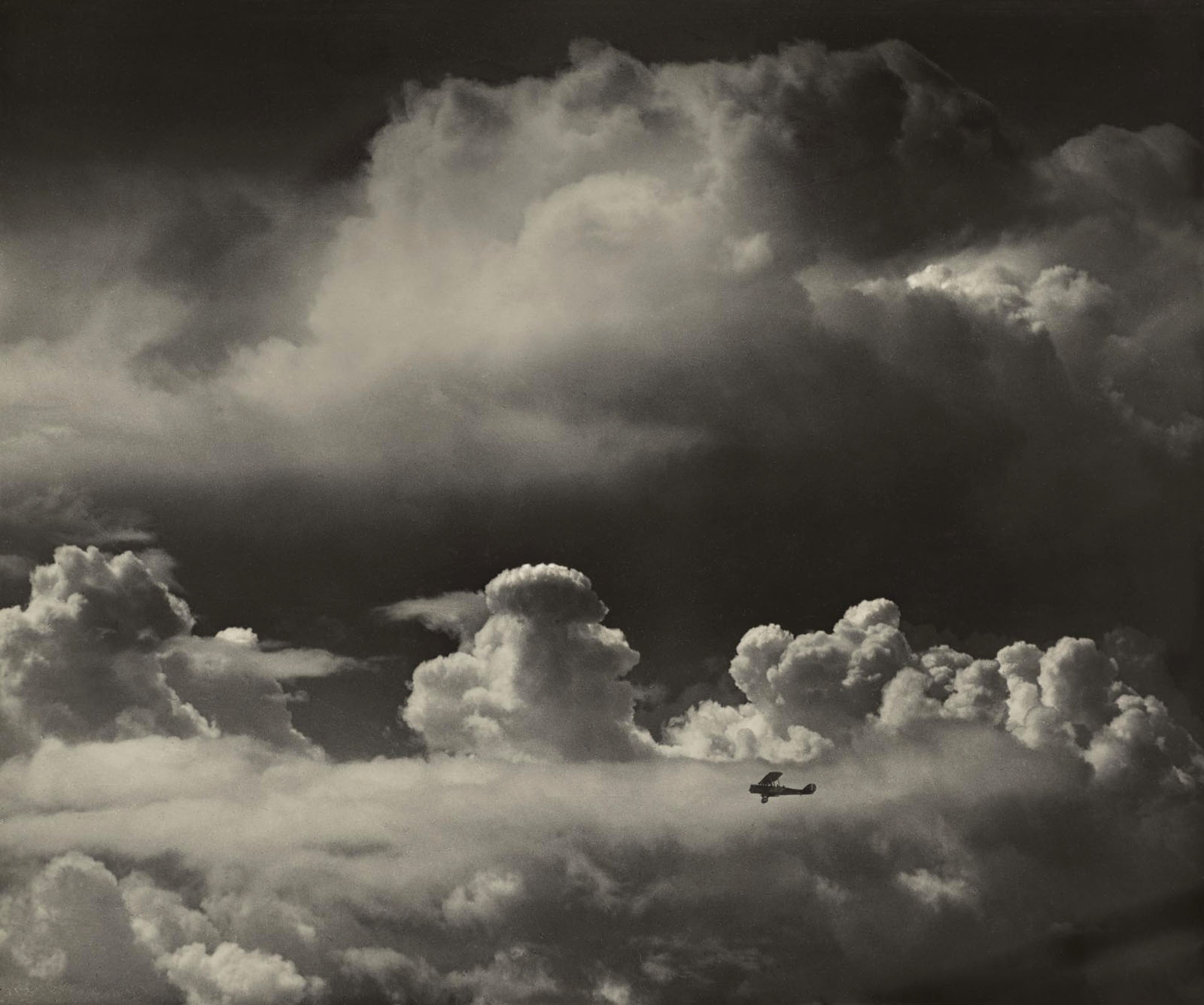
Alfred Buckham (British, 1879-1956)
Cloud Turrets
about 1920
Gelatin silver print
38.00 x 45.70cm
National Galleries of Scotland
Purchased with Art Fund support, 2008
This dramatic, and almost surreal photograph, shows the diversity of cloud formations during a fierce thunderstorm. Over the years Buckham amassed a vast collection of photographs of skies which he could integrate with a separate landscape photograph to enhance the drama and create a more impressive composition. He also often manipulated his images further by adding a hand painted aircraft, such as in this image, which heightens the viewer’s awareness of the dominating power and scale of the natural world.
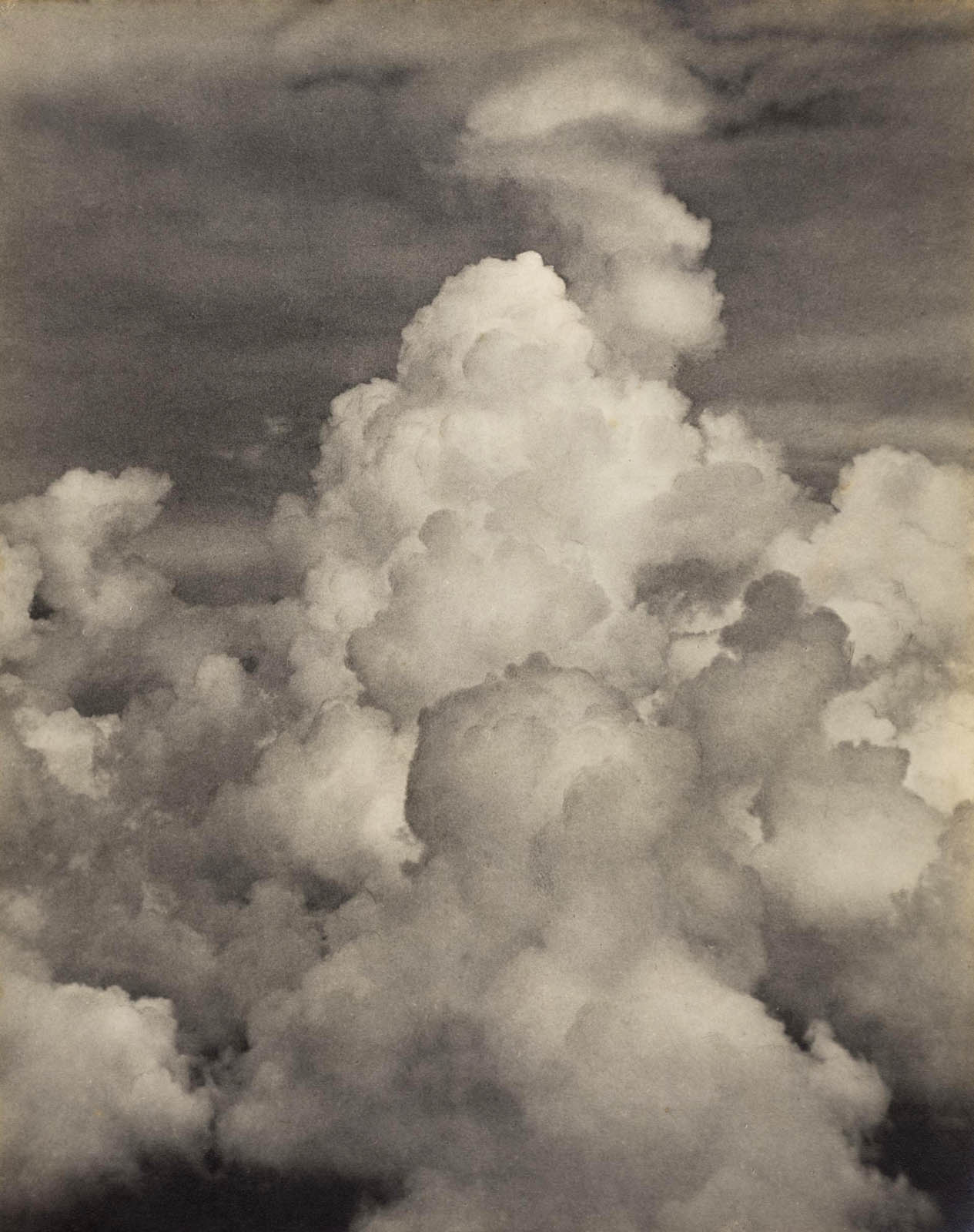
Alfred Buckham (British, 1879-1956)
Clouds Massing Before a Thunderstorm
about 1920
Gelatin silver print
37.80 x 30.00cm
Scottish National Gallery of Modern Art
Purchased with Art Fund support, 2008
Buckham was renowned for his atmospheric shots of the landscape. He felt that the most spectacular cloud formations and theatrical light could be captured on ‘stormy days, with bursts of sunshine and occasional showers of rain’. Over the years Buckham built up a vast collection of photographs of skies which he could integrate with a separate landscape photograph to enhance the drama and create a more impressive composition. This is an example of one of his shots of an impressive cloud formation before a thunderstorm.
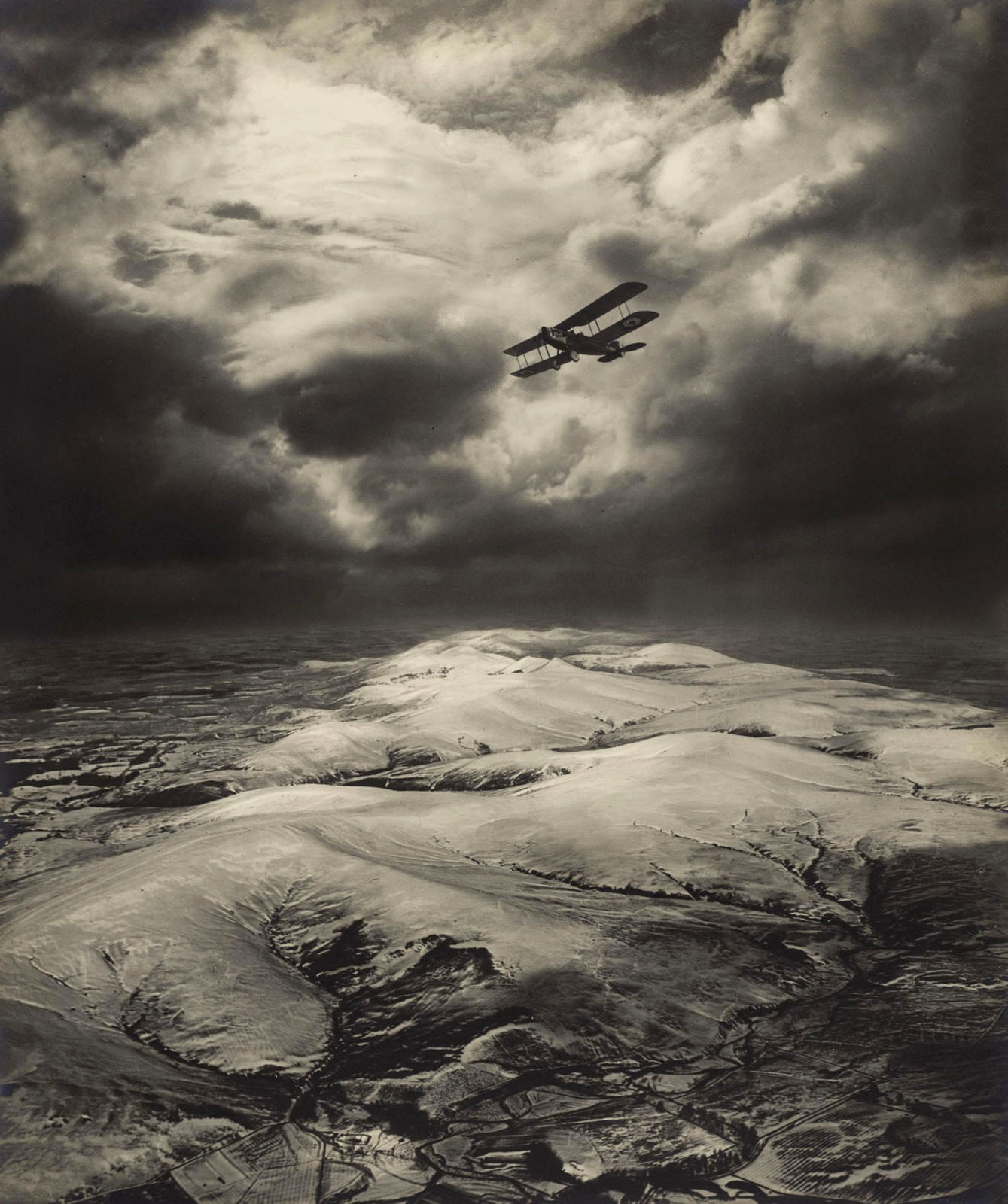
Alfred Buckham (British, 1879-1956)
Sunset over the Pentlands Range
about 1920
Gelatin silver print
46 x 38.6cm
National Galleries of Scotland
Purchased with Art Fund support, 2008
© Richard and John Buckham
Buckham was the leading aerial photographer of his day and was renowned for his atmospheric shots of the landscape. He felt that the most spectacular cloud formations and dramatic light could be captured on “stormy days, with bursts of sunshine and occasional showers of rain”. Over the years Buckham amassed a vast collection of photographs of skies which he could integrate with a separate landscape photograph to enhance the drama and create a more impressive composition. This photograph of the landscape over the Pentlands Hills near Edinburgh demonstrates this technique. It also illustrates another feature of Buckham’s photographs in the perfectly positioned silhouette of a biplane against the broken clouds, which Buckham would have painted on later.
Crafting an image | The photographic techniques of Alfred Buckham
Louise Pearson
Alfred Buckham created some spectacular photographs of the earth from the air. In 2018 curator Louise Pearson looked at how these images were created through a unique combination of daring escapades in the air and clever photographic manipulation on the ground.
Alfred Buckham was a passionate enthusiast of both photography and flight. By 1914 he was already an established photographer and a Fellow of the Royal Photographic Society. During the First World War he was involved in the relatively new discipline of aerial reconnaissance, both as a teacher and a practitioner. It was a dangerous occupation and his military career ended as a result of the injuries sustained to his throat during his ninth crash. Despite this, his wartime activities had sparked a love of flying and on leaving the Royal Naval Air Service it seemed natural that he would continue to take photographs from the sky. Buckham subsequently created an astonishing series of photographs, ranging in subject from the Forth Bridge to the skyscrapers of New York and the volcanoes of South America.
The National Galleries of Scotland holds a group of Buckham’s photographs including Edinburgh, which has become one of the most popular works of art in the collection. When we decided to have a photography exhibition on the theme of transport it was clear that Buckham’s aerial photographs would take centre stage. I selected several of Buckham’s photographs for inclusion, including Edinburgh and The Forth Bridge, and started to look at the photographs in more detail with conservator James Berry. We also started planning a blog to explain how Buckham was able to create such dramatic images.
From previous research, and the work James was doing on conserving the photographs ahead of the exhibition, we knew that Buckham was using a technique called combination printing. This is when a photographer uses a number of different negatives to create a single photographic print. In order to fully understand his working methods, we needed to see the negatives he was using. Fortunately, Alfred Buckham’s entire archive of around 1400 negatives, nearly 300 prints, camera and associated archive material has remained with his family and is currently in the care of his grandsons Richard and John Buckham. Richard kindly allowed me to spend a day at his home in London, looking through this fascinating collection. Being able to compare the negatives to the prints in our collection, and read Buckham’s accounts of his photographic work, helped us to piece together how he would have made the atmospheric photograph Edinburgh.
The first stage in taking an aerial photograph is to select the right plane. Buckham took photographs around the world and would have used a number of different planes flown by various pilots to take his photographs. However he recorded that he always preferred to use older planes with open cockpits that travelled at the fairly sedate speed of 60 to 80 miles per hour. Through trial and error he discovered that flying between 1,000 and 2,000 ft gave the best results, as at that height the landscape could be captured with just the right level of detail. …
The other essential piece of equipment was the camera. Happily, as Buckham’s camera survives, we know exactly what he was using to make his exposures. In an article written for the benefit of prospective aerial photographers, he advised using the kind of cameras used by newspaper reporters, which operated at eye-level, rather than the cumbersome cameras which had originally been developed for aerial photography. ‘The camera best suited to the purpose and the one I usually employ has a F4.5 lens and a large direct vision view-finder the same size as the plate, fitted on the top of the lens panel’. He cautioned however that the leather bellows needed to be reinforced with cardboard or aluminium, as the otherwise delicate bellows could not withstand the force of the winds encountered at altitude.
The kind of camera favoured by Buckham used glass plate negatives, which was a conscious decision by Buckham at a time when photographic film was becoming readily available. He favoured double-coated panchromatic plates made in the USA, with dimensions of 10.0cm x 12.5cm. Throughout his career he reiterated that despite their bulk and delicacy, plates gave a far superior result to film.
Extract from Louise Pearson. “Crafting an image | The photographic techniques of Alfred Buckham,” on the National Galleries of Scotland website Nd [Online] Cited 11/02/2026. Used under fair use conditions for the purposes of education and research
Alfred Buckham (British, 1879-1956)
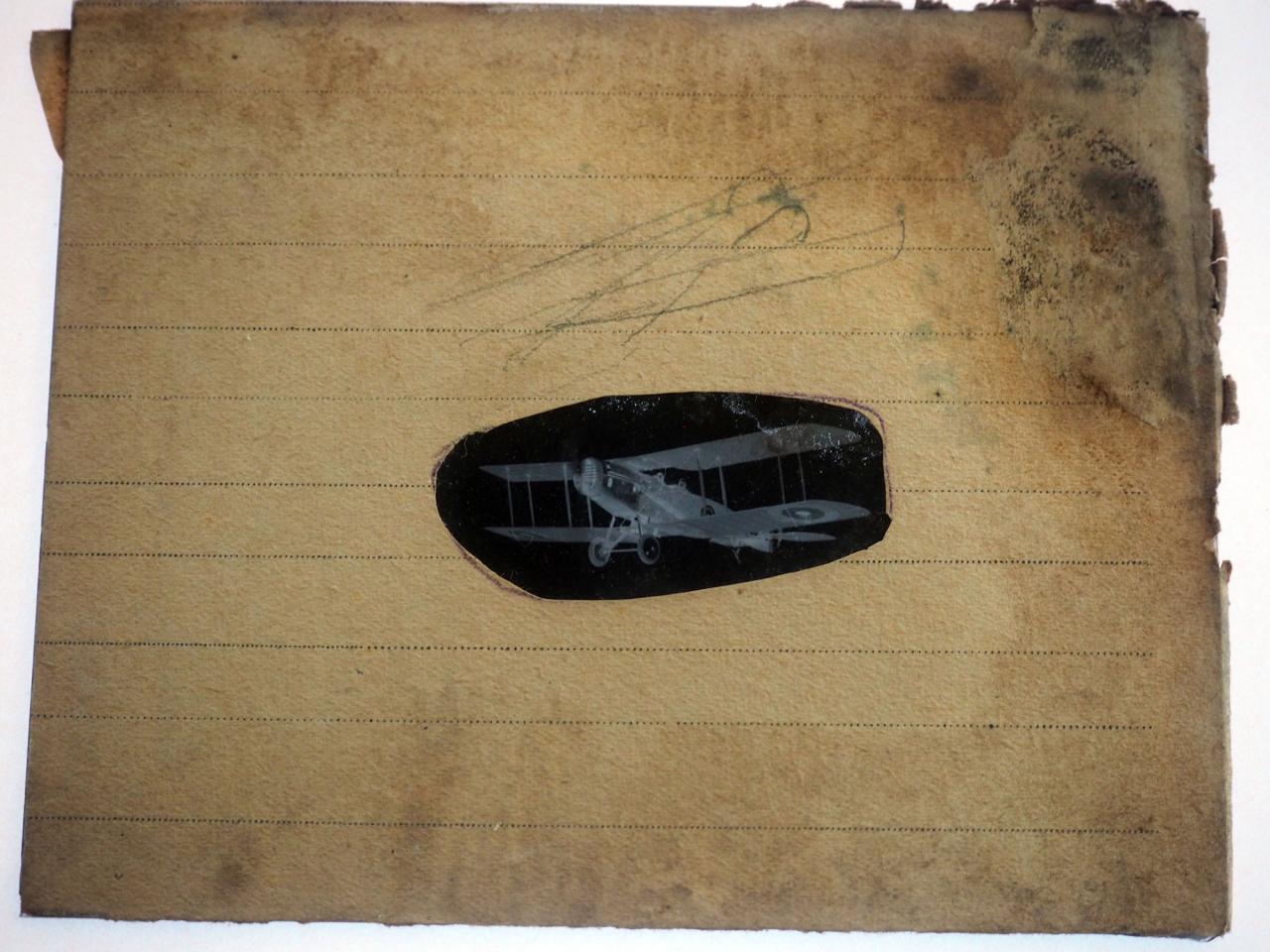
Aeroplane Negative
About 1920
© Richard and John Buckham
Buckham built up a library of negatives depicting only aeroplanes, where the original background was masked out. This meant that when the negative was exposed on top of an existing print the plane would appear to be part of the chosen landscape. Buckham would have also been able use an enlarger to match the scale of the plane to the landscape, making the scene appear realistic. While in most cases this technique produces a believable, if slightly incredible, final image there are examples where the planes appear too close together, or at impossible angles.
For Buckham, the final stage of creating a finished image was to use watercolour paints and sometimes ink to add detail to the final print and soften the areas where the two negatives meet. In some of his photographs these hand-drawn elements are easily visible, though in the case of Edinburgh they are more subtle. The clouds on the horizon have been softened to make the join where the two negatives meet less noticeable in the finished print, highlights have been added to the clouds to make them more dramatic and the light below Arthur’s Seat has been adjusted to better match the clouds above. In addition, some areas have been highlighted and others darkened to sharpen the details of key landmarks and make them more recognisable. The use of black watercolour or ink to strengthen and define specific areas of the photographs shows Buckham’s ingenuity. Whilst other photographers would alter the negatives and perhaps scratch out an area that they wished to appear darker, Buckham added the darker tone to the photographic print itself. He also used a scratching out technique, similar to Turner, where a dark area of the photograph is scratched revealing the lighter colour of the paper beneath. This artistic intervention results in each photograph being a unique piece of work. No two can be exactly the same.
It is clear then that Buckham’s photographs are not the result of a single, breath-taking moment in time but instead are a carefully crafted piece of art. He was using known photographic techniques, but created a style which was very much his own. As a result it is easy to see why Edinburgh has become one of the most popular artworks in the collection.
Extract from Louise Pearson. “Crafting an image | The photographic techniques of Alfred Buckham,” on the National Galleries of Scotland website Nd [Online] Cited 11/02/2026. Used under fair use conditions for the purposes of education and research
Alfred Buckham (British, 1879-1956)
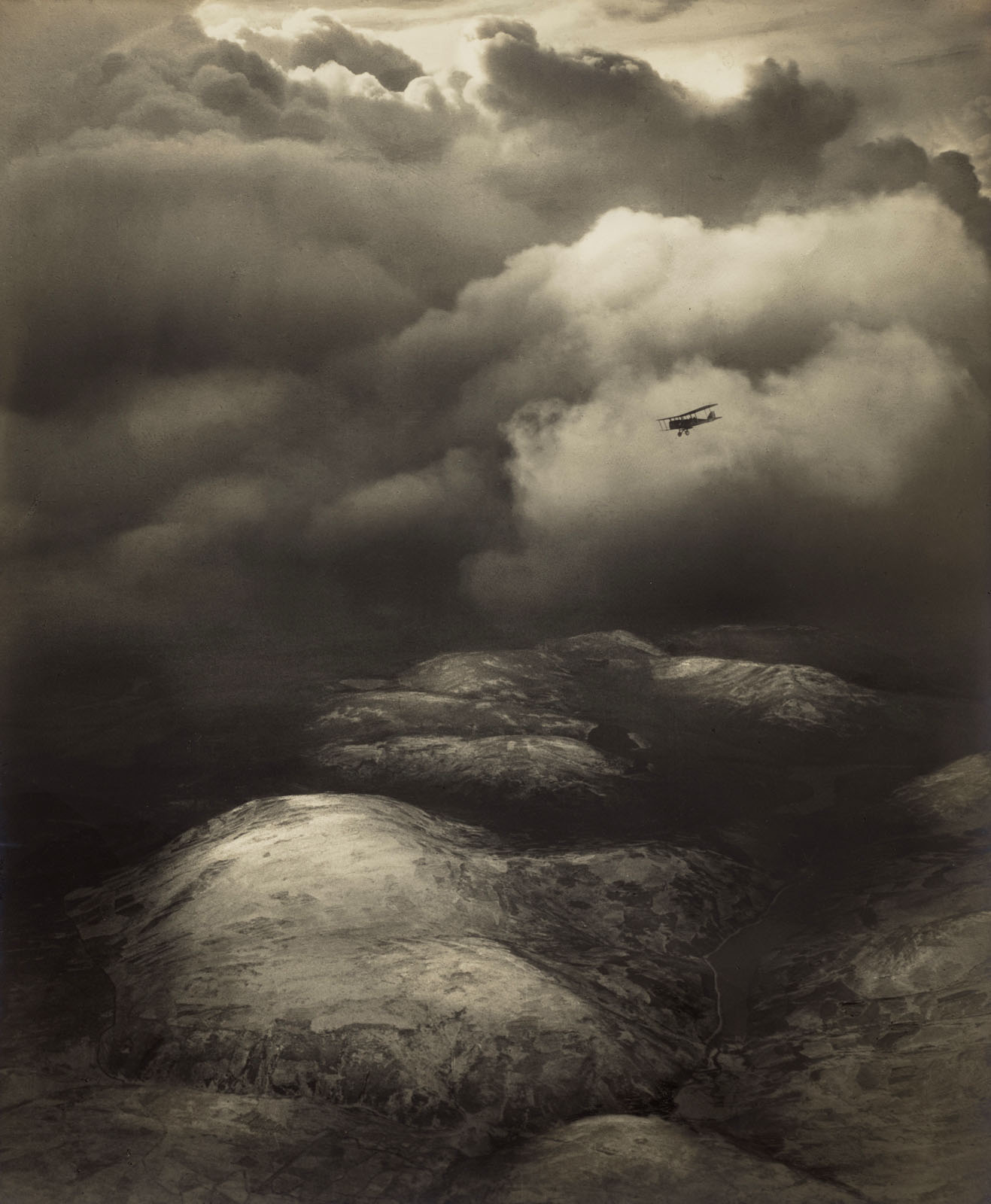
Uplands Snowstorm Passing
about 1920
Gelatin silver print
National Galleries of Scotland
Purchased with Art Fund support, 2008
© Richard and John Buckham
In this image the undulations of the snow covered hills are mirrored in the cloudy sky. Buckham introduces a sense of scale through the lone plane silhouetted against a cloud.
Alfred Buckham (British, 1879-1956)
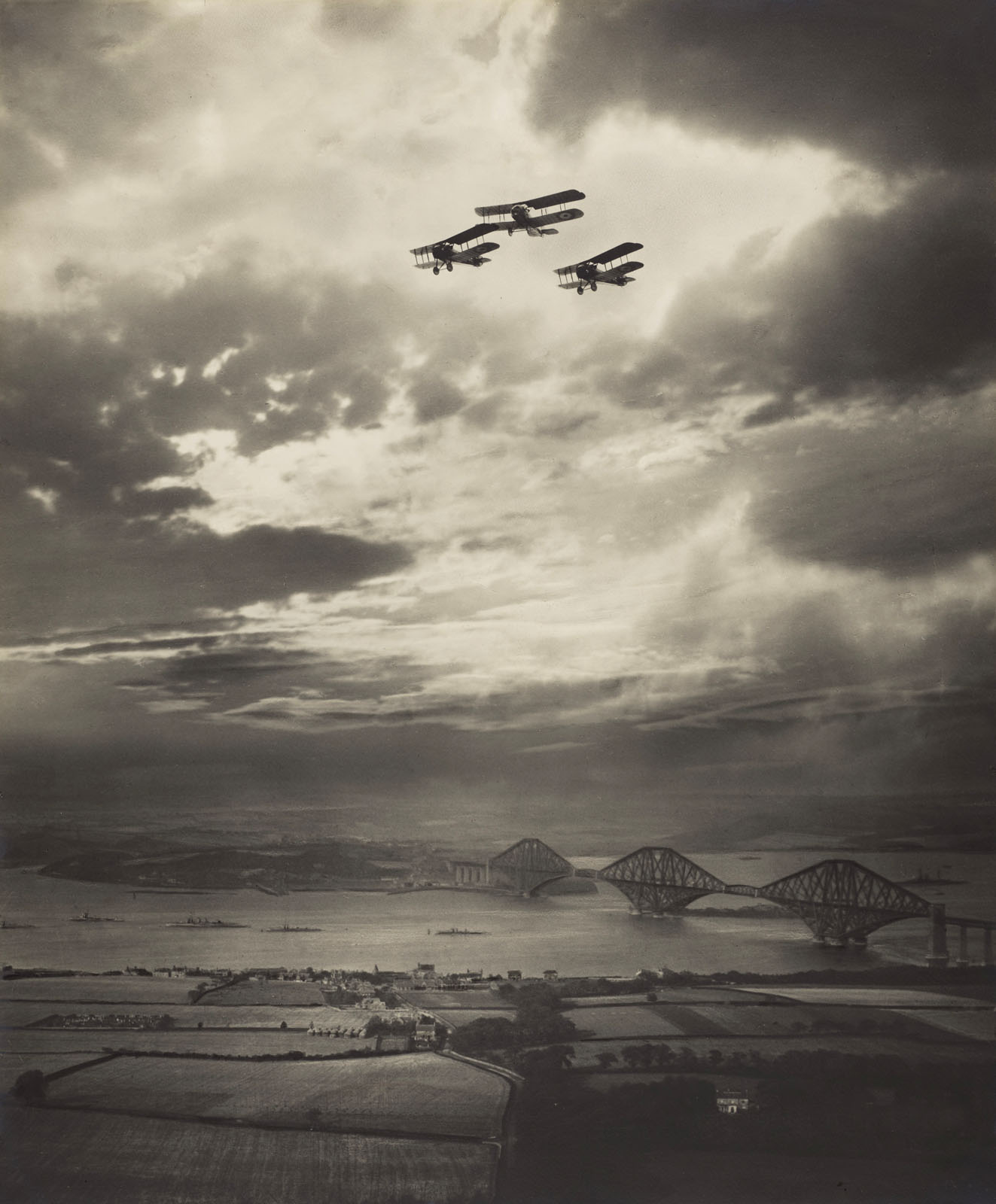
The Forth Bridge
about 1920
Gelatin silver print
National Galleries of Scotland
Purchased with Art Fund support, 2008
© Richard and John Buckham
Buckham felt that the most spectacular cloud formations and theatrical light could be captured on ‘stormy days, with bursts of sunshine and occasional showers of rain’. This creativity led to him being regarded as the leading aerial photographer of his day and he was renowned for his atmospheric shots of the landscape. Over the years he amassed a vast collection of photographs of skies which he integrated with a separate landscape photograph to enhance the drama and create an imposing composition. This image over the Firth of Forth, Scotland, encapsulates the romantic fusion of man’s engineering achievements against the dramatic beauty of nature. The three steel arches of the Forth Rail Bridge are mirrored in the three biplanes, which Buckham added later by hand, silhouetted against the spectacular sky.
Alfred Buckham (British, 1879-1956)
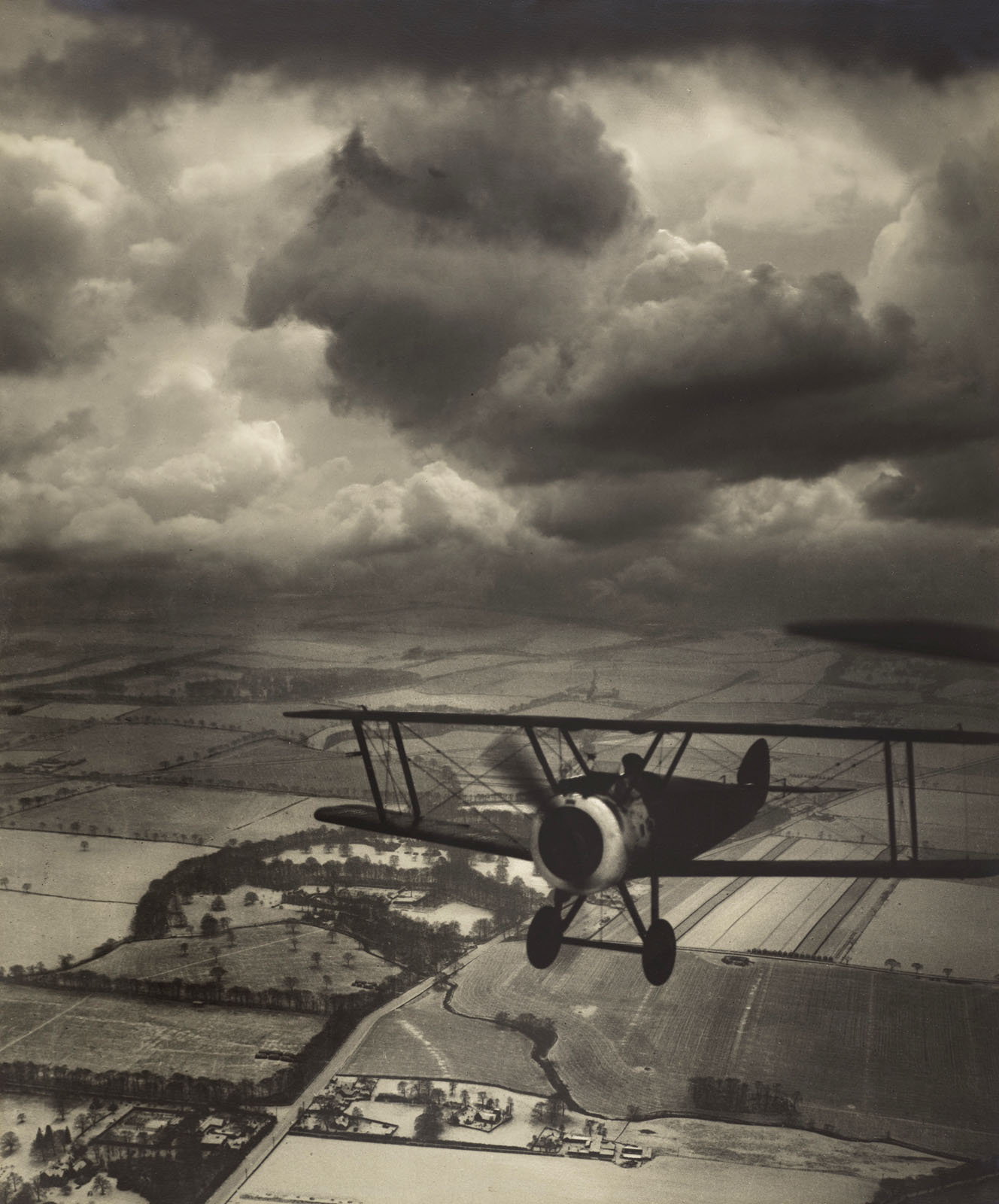
Sunshine, and Showers
about 1920
Gelatin silver print
National Galleries of Scotland
Purchased with Art Fund support, 2008
© Richard and John Buckham
This image shows Captain Jordan flying his Black Camel biplane at very close proximity to Buckham’s aircraft. Taken over the landscape around Rosyth, Fife, Scotland this was near to where Buckham crashed for the ninth time in 1918 and sustained serious injuries.
This autumn at the Portrait gallery in Edinburgh, take to the skies and see the world from above the clouds through the remarkable work of Alfred Buckham: Daredevil Photographer. From 18 October 2025 – 19 April 2026, meet the man behind some of the most iconic aerial photographs ever taken, marvel at the death-defying lengths he took to capture the perfect image and explore how his innovative techniques in the darkroom paved the way for modern technologies such as Photoshop and AI. Free to visit at the National Galleries Scotland: Portrait, this will be the first major exhibition dedicated to Alfred Buckham and can only be seen in Scotland.
This exhibition will bring together over 100 photographs and objects including popular works from the Scottish national collection, alongside extensive archival material generously loaned by Alfred Buckham’s grandsons, Richard and John Buckham. Thanks to the support of the Buckham family, personal objects including letters, photographs and even the passport Alfred Buckham used will be put on public display for the first time.
A maverick of early aviation, Alfred Buckham (1879-1956) created his own unique style of photography by combining daring exploits in the air with innovation in the darkroom. Born in London, Buckham learned his craft by teaching photography before joining the Royal Naval Air Service in 1916, a predecessor to the Royal Air Force. Hailed as an exceptionally skilled flyer, he combined his talent for aviation with his passion for photography, resulting in remarkable endeavours and trailblazing images. Based for most of his military career at RAF Turnhouse, now Edinburgh Airport, central Scotland became a natural playground for Buckham to refine his photographic techniques and let his imagination soar. Daredevil Photographer will chart his phenomenal story from his early photographic experiments in Scotland to exciting adventures in South America and look closer at the skilled and inventive ways he created his work.
Explore Scotland from the air and get a new perspective of well-known sights, just as Buckham himself would have. Daredevil Photographer celebrates the impact Scotland had on Buckham’s work through his images of recognisable landmarks including St Andrews Golf Links, Linlithgow Palace and the Wallace Monument in Stirling. The exhibition will also feature several images of the Forth Rail Bridge, Buckham’s most photographed landmark. The iconic bridge was the subject of one of his first composite photographs and appeared on the 1918 RAF Turnhouse Christmas card, which will go on display alongside the original photography.
Daredevil Photographer will delve into the darkroom and uncover more about the creative processes used to bring Buckham’s unique images to life. After the First World War, Buckham began experimenting with composite photography; a technique where several negatives are used to create one photographic print. While this wasn’t a new concept, composite photography added a layer of creative freedom to Buckham’s work, much like a very early form of Photoshop. From his vast collection of glass negatives – he had over 2000 cloud images alone in his ‘cloud library’ – Buckham had the means to create images which became immersive, giving a unique sense of flying alongside these incredible aircraft while viewing the world below.
It was through the technique of composite photography that some of Buckham’s most famous works were born, including the iconic aerial view of Edinburgh (about 1920). This striking photograph shows a bi-plane hovering amongst wispy clouds above Edinburgh Castle, with Arthur’s Seat visible through the mist in the background, and the bustling city below. For the first time, Edinburgh will be displayed alongside the camera and original glass negatives Buckham used to capture and create this much-loved image. Visitors will also be encouraged to get inspired and try their hand at creating their own composite creations through interactive exhibits.
Telling Buckham’s story through his own words and memories, Daredevil Photographer allows visitors to meet the courageous and humorous man behind the camera. Firsthand accounts of his incredible exploits in the air and ingenious creative methods on the ground will enhance his story and highlight his adventurous spirit: Ah! One was a rare daredevil in those days! (Alfred Buckham, The New York Times, 1930). A free and unique immersive audio experience will bring Buckham’s world of flight and imagination to life through his own words. Hear Buckham’s grandson Richard give a voice to his grandfather’s memories and reflections on his daredevil persona.
Daredevil in every sense of the word, Buckham went to incredible feats to capture the perfect shot, which the exhibition will explore. His preferred methods included standing in an open cockpit while mid-air, with his leg tied to the seat as a nod to safety. As a result, he experienced no less than nine crashes in his lifetime, one ending in a serious throat injury that cut his military career short. However, he would not be deterred, describing his eccentric photography methods in a surprisingly relaxed way:
“It is not easy to tumble out of an aeroplane, unless you really want to, and on considerably more than a thousand flights I have used a safety belt only once, and then it was thrust upon me. I always stand up to make an exposure and, taking the precaution to tie my right leg to the seat, I am free to move rapidly, and easily, in any desired direction; and loop the loop; and indulge in other such delights, with perfect safety” – Alfred Buckham, The Camera, January 1927.
Daredevil Photographer will celebrate Buckham’s skill in the air through a range of his mesmerising photographs. Encounter stunning images of the leading aircraft of the day, such as the Bristol Fighter, a two seated bi-plane designed for aerial reconnaissance, and the bizarre airships of the 1920s. See them soaring through the skies in all weathers, amongst an array of remarkable landscapes. The exhibition will include one of his most well-known works, The Heart of the Empire (1923), on loan from the V&A Museum in London and displayed in Edinburgh for the first time. The photograph follows a bi-plane as it glides across the London skyline, with landmarks such as Tower Bridge and the River Thames in view. Exhibited by the Royal Photographic Society in 1925, The Heart of the Empire secured Buckham’s position as one of Britain’s leading aerial photographers.
Experience the golden age of travel through Buckham’s portfolio of images spanning across the globe. In 1931, a commission from Fortune Magazine took Buckham on an epic fifteen-week trip across the Americas, covering 19,000 miles and setting a world record. Starting in New York City and taking the opportunity to capture the newly built Empire State Building, Buckham photographed his intrepid journey from the United States to the tip of South America to share with the world. Daredevil Photographer will chart Buckham’s incredible journey, from expansive views of Christ the Redeemer in Rio De Janeiro and the snowy caps of the Andes Mountains to perilous scenes of smoking volcanic creators in Guatemala and Mexico. Through his death-defying adventures and stunning photographs, Buckham expanded public understanding of the world, creating an exciting legacy which continues to capture imaginations today.
Louise Pearson, curator of photography at the National Galleries of Scotland says: “Alfred Buckham’s eye-catching photograph of Edinburgh is one of the most popular artworks in the National Galleries of Scotland collection. This enthralling image becomes even more intriguing when you learn that it is a darkroom jigsaw – a composite photograph made through a combination of technical skill and creative vision. Alfred Buckham: Daredevil Photographer tells the remarkable story of this maverick of early aviation whose adventures took him from aerial reconnaissance photographer to intrepid explorer via numerous loop the loops.”
Press release from National Galleries of Scotland
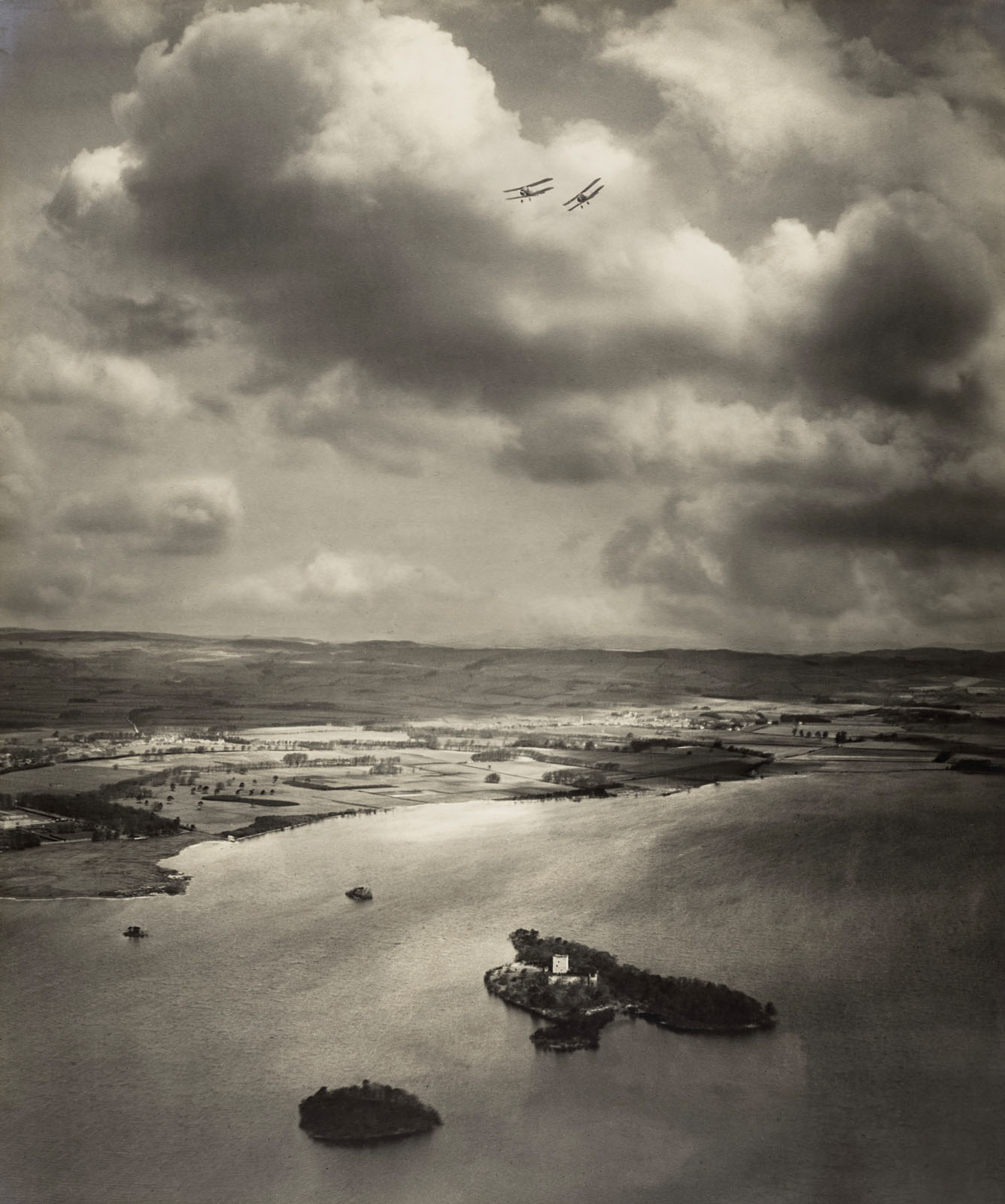
Alfred Buckham (British, 1879-1956)
Castle Island Loch Leven (Where Mary Queen of Scots was Imprisoned)
about 1920
Gelatin silver print
National Galleries of Scotland
Purchased with Art Fund support, 2008
© Richard and John Buckham
This photograph of Castle Island, where Mary, Queen of Scots was imprisoned in 1567, shows the vast expanse of the rolling countryside around Loch Leven, Scotland. The cloudy sky enhances the depth of the image and the small biplanes, which Buckham added later by hand, reinforce the dramatic scale.
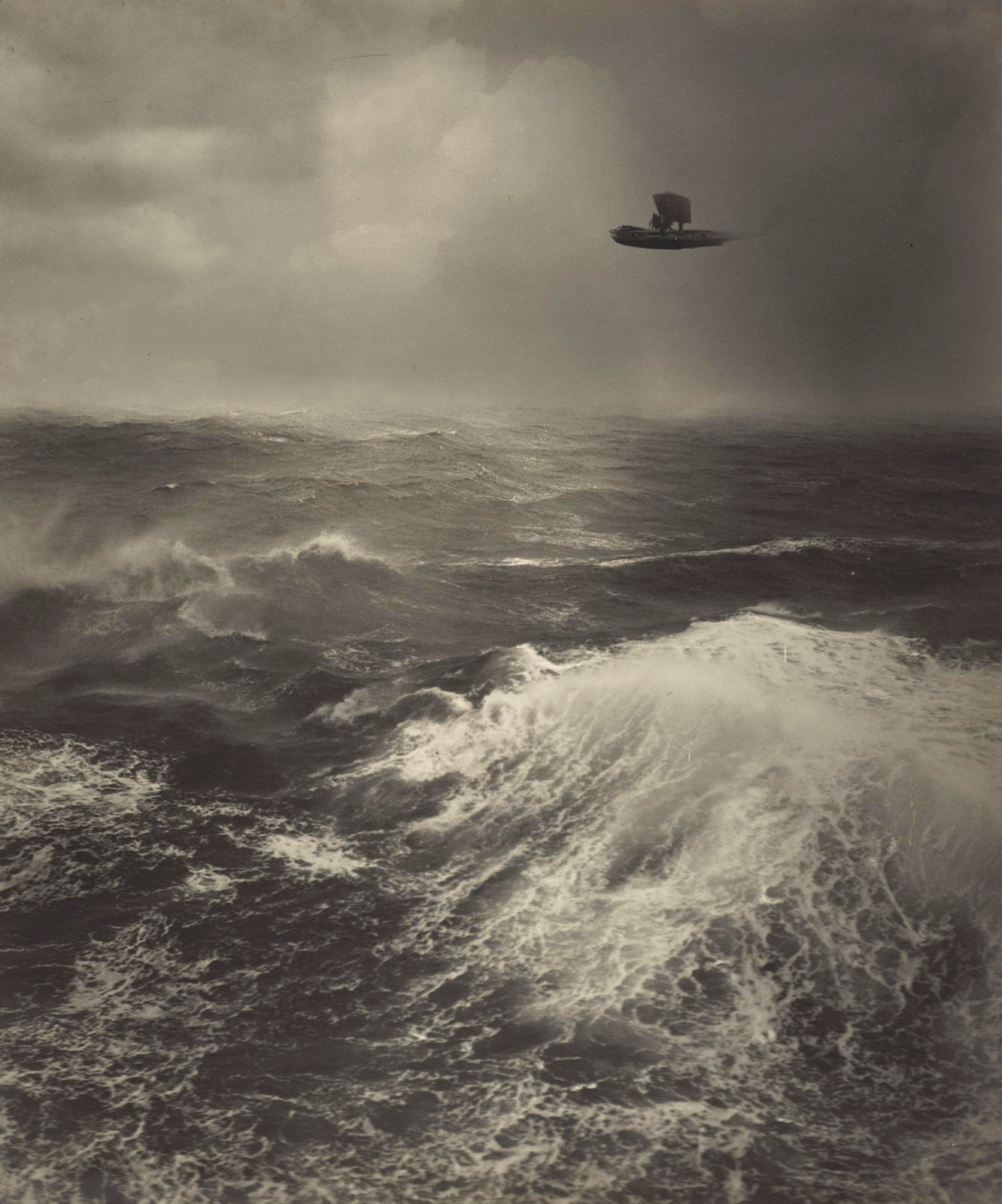
Alfred Buckham (British, 1879-1956)
Flying Boat Over Sea
1930
Gelatin silver print
45.5 x 37.6cm
National Galleries of Scotland
Purchased with Art Fund support, 2008
This photograph captures the stormy ocean with its swelling crests of the waves illuminated white. Silhouetted against the threatening sky is a flying boat. This specialised form of aircraft was purposely designed to take off from, and land on, water. This feature was exploited during the World Wars but its use rapidly declined thereafter. Buckham was aware of the flying boat from his time in the Royal Naval Air Service and, specifically, his involvement in photographing the alterations required that allowed planes to take off from, and land on, a ship.
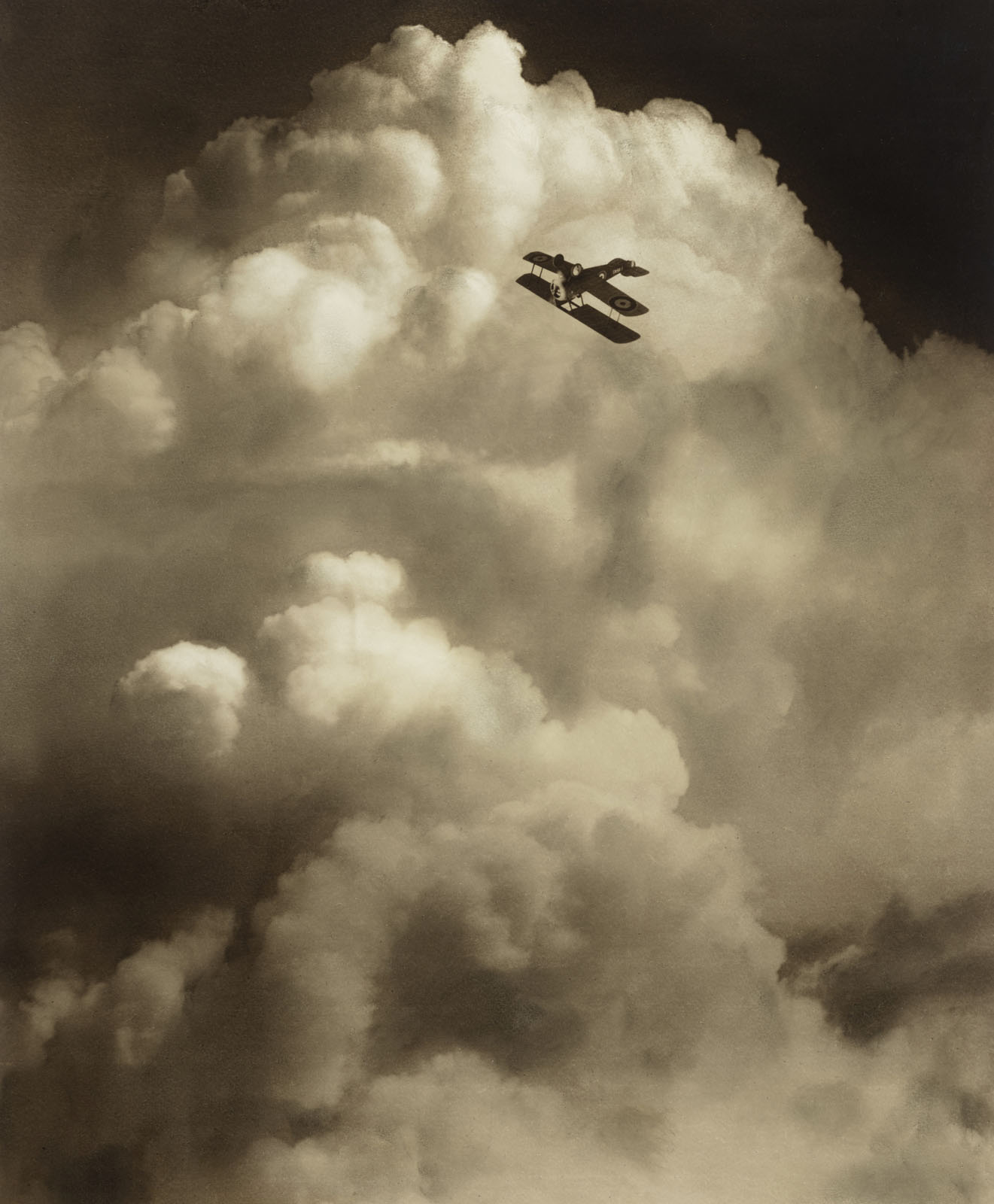
Alfred Buckham (British, 1879-1956)
The Loop
about 1930
Gelatin silver print
National Galleries of Scotland
Purchased in recognition of over 40 years of work on the National Galleries of Scotland photography collection by James Berry, Senior Paper Conservator
© Richard and John Buckham
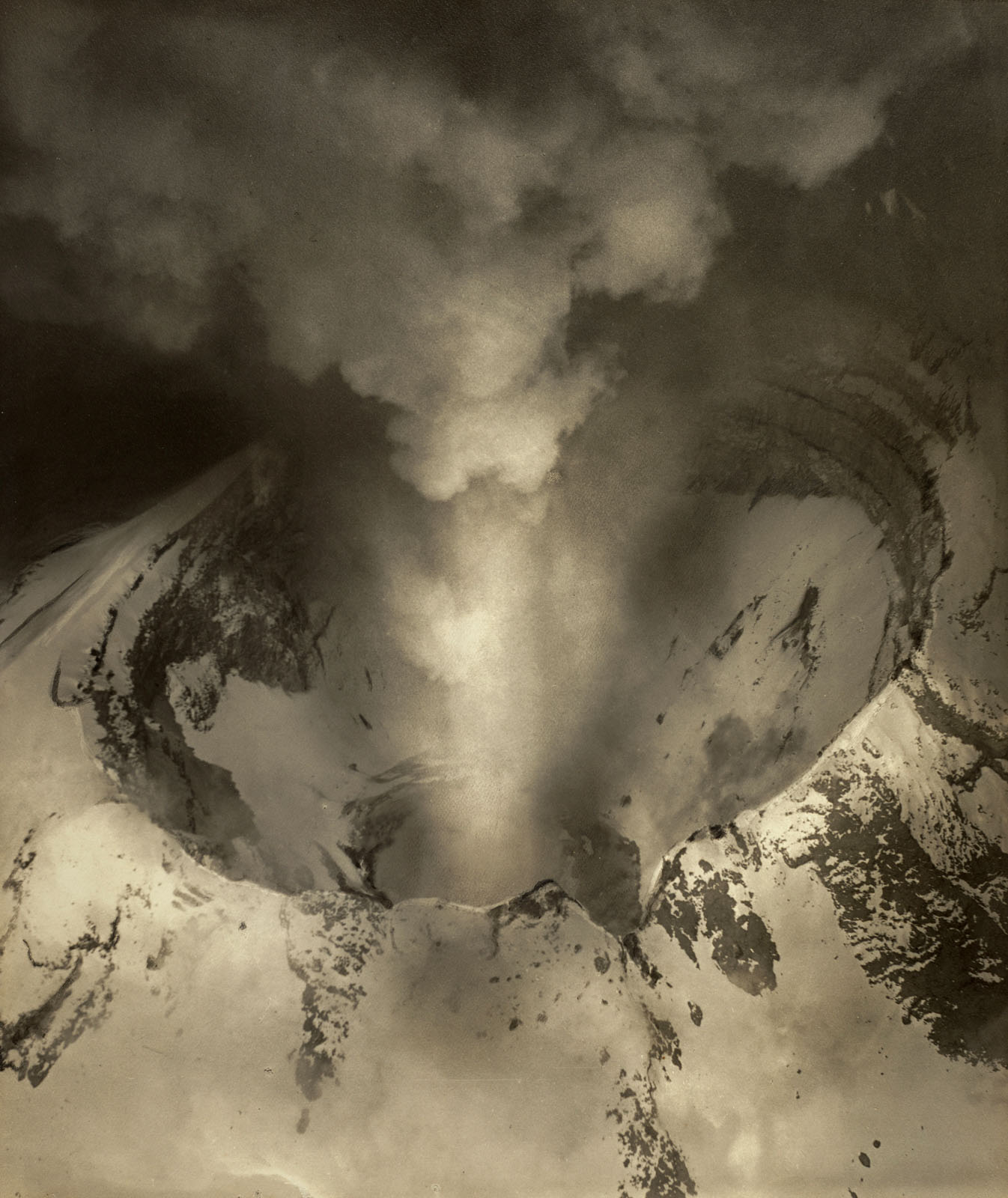
Alfred Buckham (British, 1879-1956)
Volcano Crater of Popocatepetl
about 1930
National Galleries of Scotland
Purchased with Art Fund support, 2008
© Richard and John Buckham
In 1930 Buckham was commissioned by Fortune magazine to produce a portfolio of aerial photographs of his chosen area of the Americas. Buckman opted for central and South America and this dramatic photograph captures the centre of Mexican volcano, Popocatepetl. The snow covered edge of the crater contrasts against the ominous dark sky, creating a shot which captures the awe-inspiring power of an active volcano. Buckham described the journey of the flight as his aeroplane turned down into the crater: ‘Almost at once the aeroplane dropped about two hundred feet… Beneath us the circular lake of boiling lava emitted numerous spouts of smoke and steam, whilst round its edge played occasional fires which, suddenly springing up and flickering awhile, as suddenly disappeared.’
Alfred Buckham: Daredevil Photographer
Paperback – 12 Nov. 2025 by Louise Pearson (Author), James Crawford (Other Contributor)
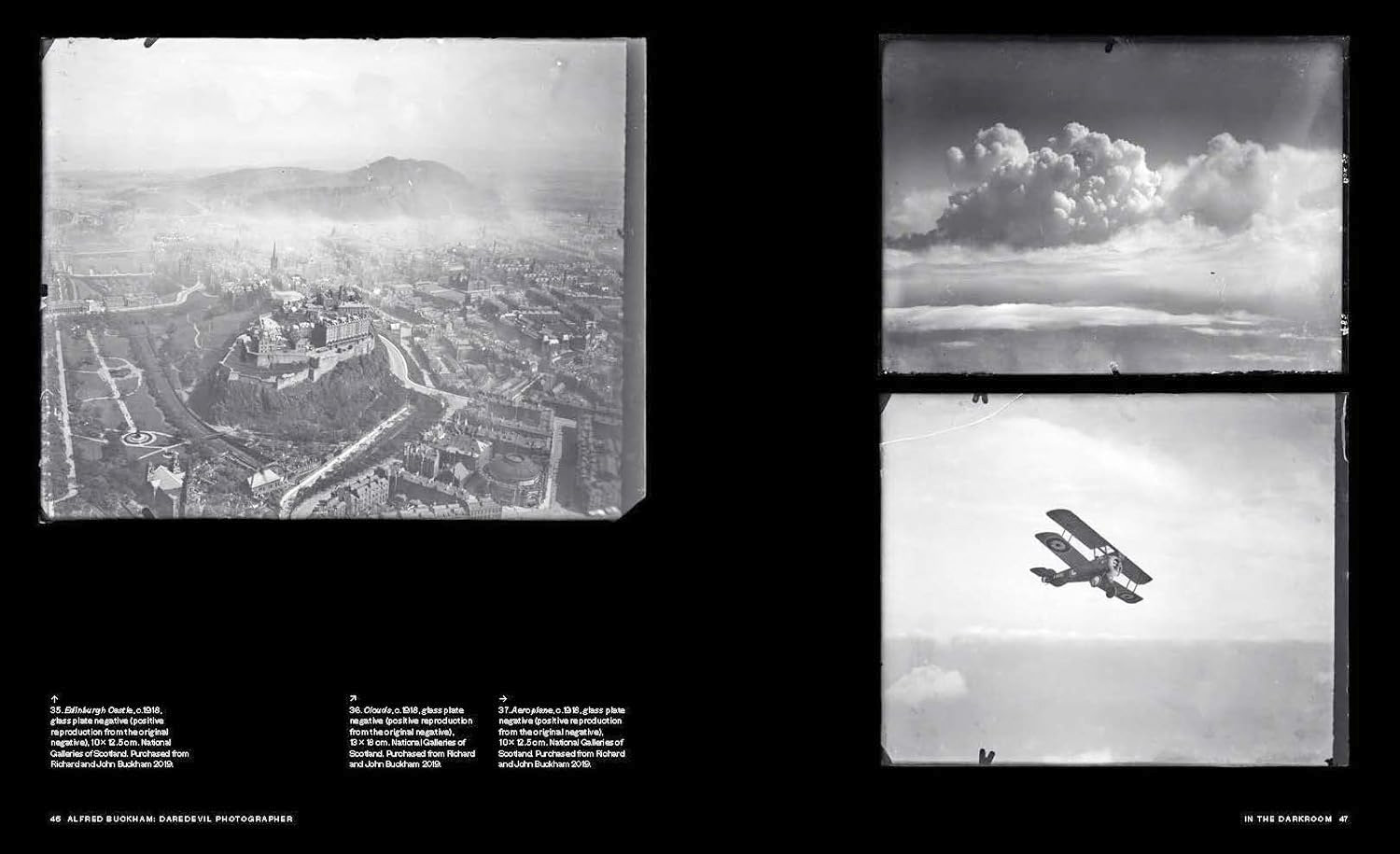
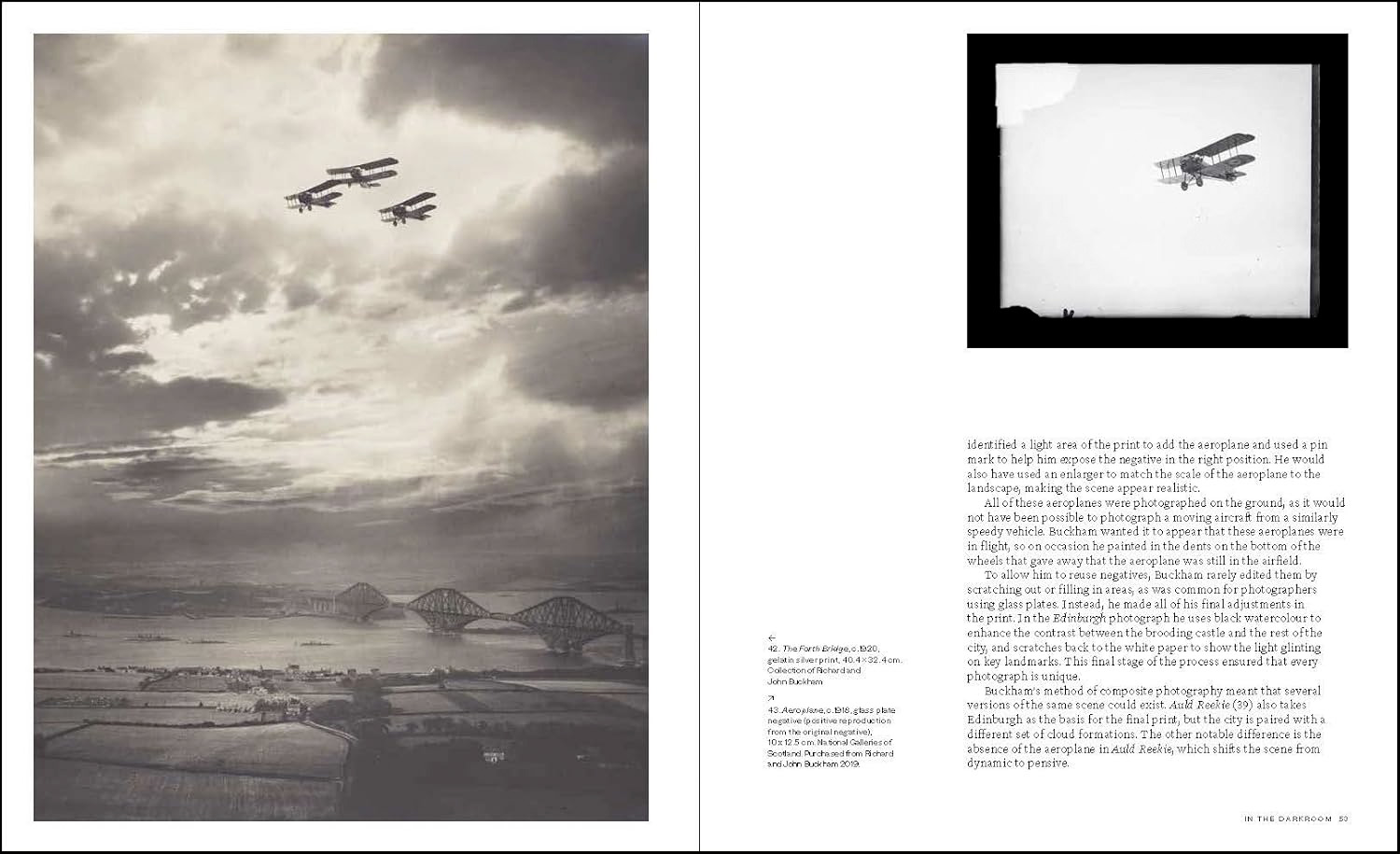
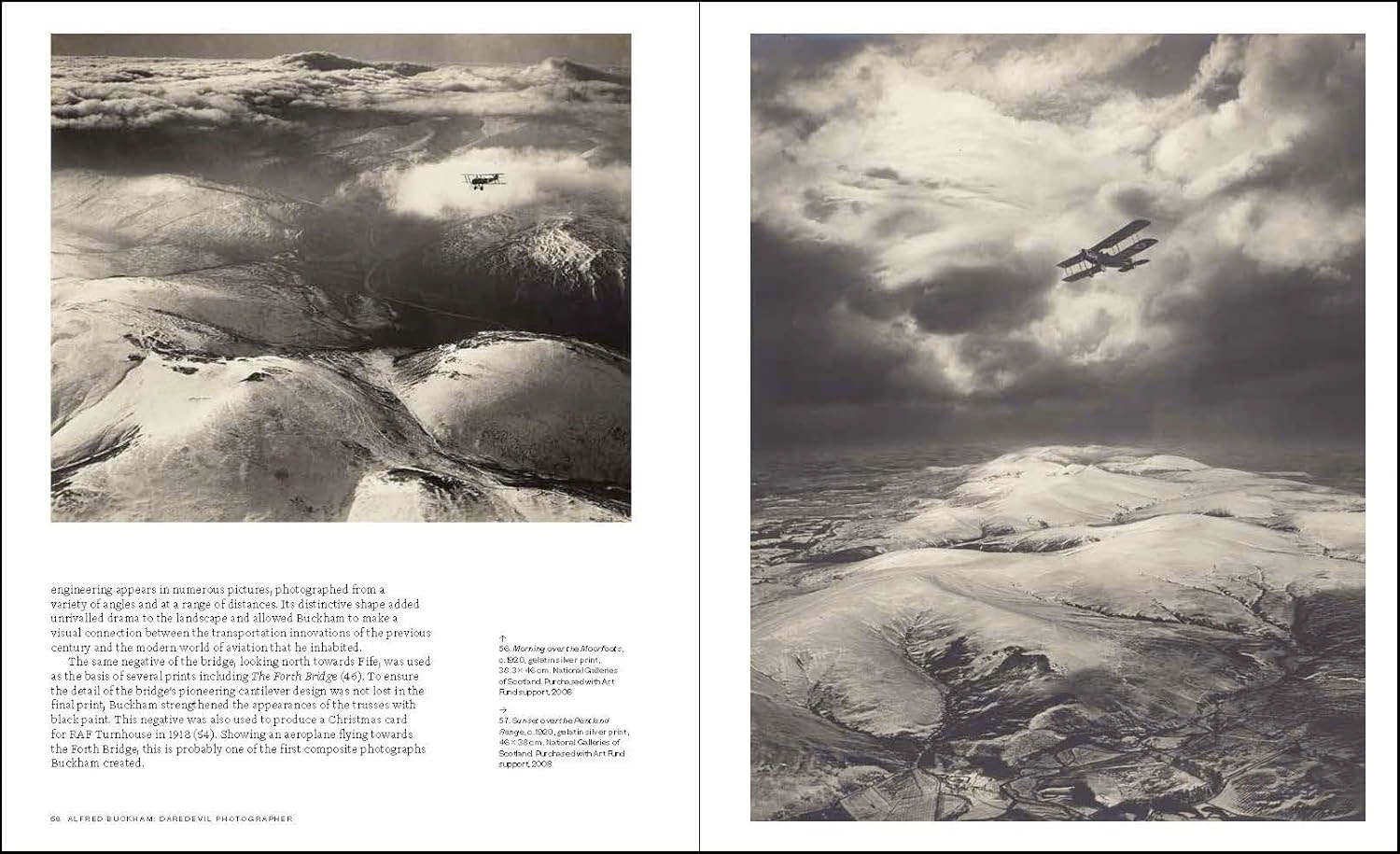
Alfred Buckham: Daredevil Photographer paperback November 2025, book pages
Scottish National Portrait Gallery
1 Queen Street, Edinburgh,
EH2 1JD, Scotland
Opening hours:
Daily, 10am – 5pm
 Art Blart _ art and cultural memory archive
You must be logged in to post a comment.